Choosing the right Melbourne accountant isn't just about finding a number cruncher. It’s about securing a financial co-pilot for your business. The best ones do more than just lodge your BAS; they provide critical insights you need to grow and stand out in a tough market.
Why a Great Accountant Is a Strategic Partner
A lot of small business owners only think about their accountant when tax time rolls around. But seeing them purely through a compliance lens means you’re missing out on the massive value they can offer as a strategic advisor.
Think about a local cafe owner in Fitzroy. With guidance from their accountant, they dig into their sales data and pinpoint the most profitable items on the menu. This insight leads them to tweak their offerings and boost their margins. That same advisor then helps them prepare detailed cash flow projections to secure financing for a second location in South Yarra.
This is what a modern, effective accountant does. They're a partner who gets the unique Melbourne market and helps you make smarter business decisions.
Beyond Tax Time Support
A proactive accountant provides value all year round, not just in the lead-up to your annual tax return. Their real job is to offer forward-looking guidance that strengthens your business's financial health. You can take a deeper dive into why every business needs an accountant to really understand the full scope of benefits.
Here’s a taste of what they can bring to the table:
- Cash Flow Management: Helping you properly understand the money moving in and out of your business so you can avoid painful shortfalls.
- Strategic Planning: Assisting with budgeting, forecasting, and setting financial goals you can actually hit for long-term growth.
- Business Structure Advice: Guiding you on how your business is set up for operational efficiency and legal soundness from day one.
A truly great accountant doesn't just report on what's already happened; they help you shape what's next. They translate complex financial data into actionable insights, empowering you to navigate challenges and seize opportunities with confidence.
Ultimately, finding the right Melbourne accountant is a serious investment in your business’s future. This guide will walk you through the process of finding that indispensable partner.
Defining Your Needs Before You Start Your Search

Before you even think about typing "Melbourne accountant" into Google, let's take a step back. Seriously, this is the most important part of the whole process. If you jump the gun, you could easily end up with someone who’s way too basic for your growing business, or worse, someone whose fees are just too steep for where you're at right now.
Think about it this way: a freelance graphic designer working from their Brunswick apartment likely just needs a hand with their quarterly BAS and sorting out their annual tax return. But a construction company in the western suburbs with a crew of tradies? That's a whole different kettle of fish. They're juggling project costing, payroll for multiple employees, and subcontractor payments.
Your mission here is to sketch out a clear brief of what you actually need. A little bit of homework now will save you a ton of time later, letting you instantly filter out the firms that aren't a good fit.
Creating Your Accountant Wishlist
So, what are the financial headaches that keep you up at night? Is it the constant worry about cash flow, or is getting your head around superannuation for your staff giving you grief? The answers to these questions will point you straight to the kind of support you need.
Let’s get practical. Which of these are absolute non-negotiables for your business today?
- Bookkeeping and Reconciliation: Are you happy coding transactions yourself, or do you need someone to take this completely off your plate?
- Payroll and Superannuation: If you have staff, this is a must-have. Getting it wrong is not an option.
- BAS and GST Lodgements: A fundamental for most Aussie businesses to stay on the right side of the ATO.
- Cash Flow Forecasting: Invaluable if you're managing growth, dealing with seasonal sales dips, or planning big projects.
- Strategic Business Advisory: Do you just want a number-cruncher, or are you looking for a partner who can help you see the bigger picture and plan for the future?
Doing this quick self-assessment changes everything. You're no longer on a vague hunt for an "accountant" – you're on a targeted mission for a specific financial partner. This clarity means you won't waste money on services you don't need or hire someone who can't keep up with your ambitions.
You should also consider if you need specialist knowledge. A tech startup, for instance, would benefit hugely from an accountant who understands the R&D tax incentive. A sole trader, on the other hand, needs someone who can give them clear guidance on concepts like paying themselves correctly. If that sounds like you, our guide on understanding owner's drawings for a small business is a great place to start.
Once you have this checklist sorted, you’re ready to find the perfect Melbourne accountant for you.
Okay, you've figured out what your business needs from an accountant. Now for the fun part: actually finding one in Melbourne. Your first instinct might be to punch "accountant Melbourne" into Google, but hold off on that for a second. The best place to start is with the official industry bodies.
Think of the directories for CPA Australia and Chartered Accountants ANZ as your first filter. These are the big players, the ones that set the professional and ethical standards. Any accountant listed here is legit, which immediately weeds out anyone who isn't properly qualified. Go through their public practice lists and aim to pull together a shortlist of about five to seven firms that look like they might be a good fit.
Verifying Credentials and Reputation
With a handful of names on your list, it's time to do a bit of digging. The absolute most important check is to make sure they're a registered tax agent with the Tax Practitioners Board (TPB). This isn't just a nice-to-have; it's a legal requirement. Only registered agents can legally prepare and lodge tax returns for you in Australia, so this is non-negotiable.
This quick flowchart gives you a good visual of how to tackle the vetting process from here.
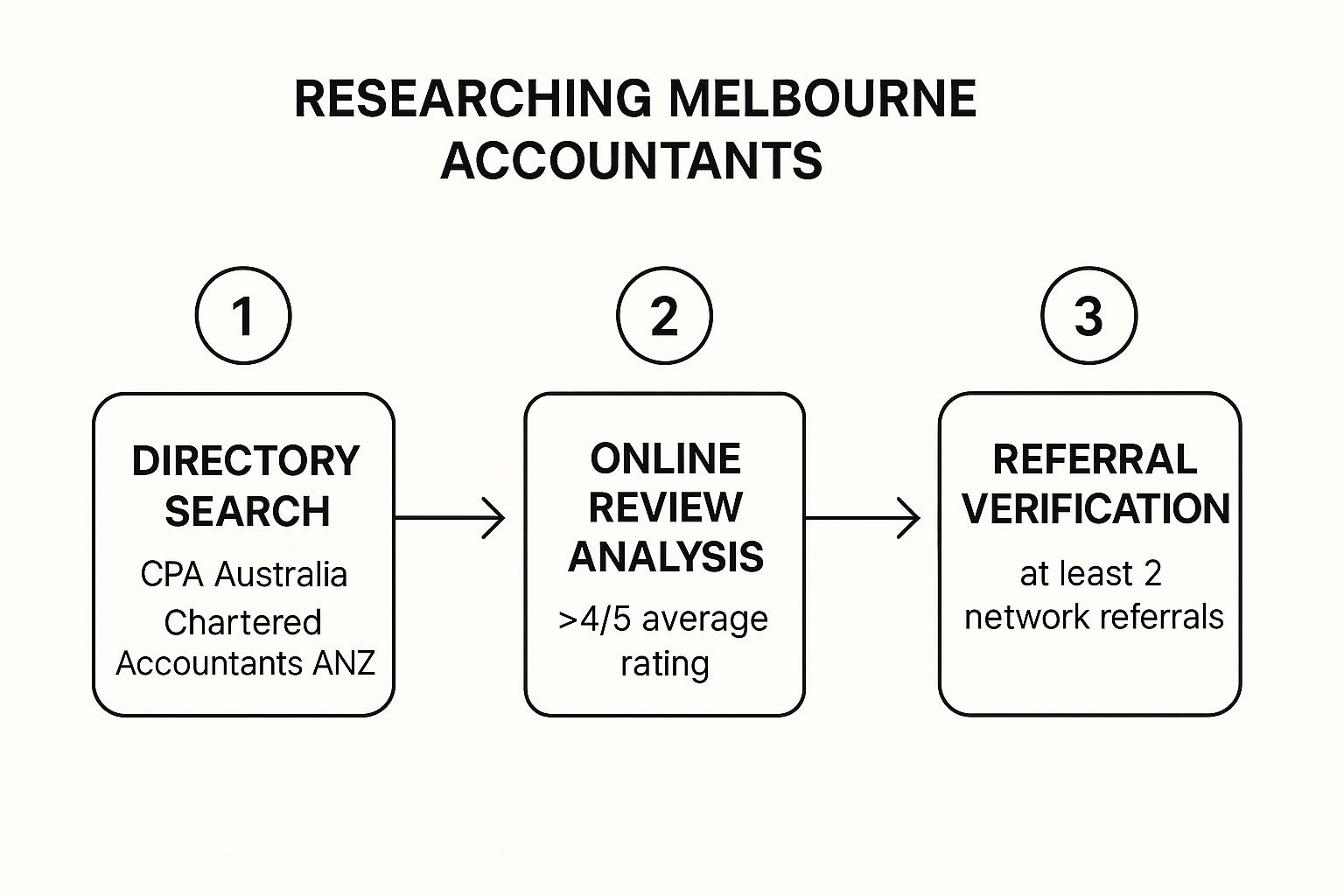
As you can see, it's a mix of official checks, seeing what people are saying online, and good old-fashioned word-of-mouth. Once you've confirmed their credentials, jump onto Google and see what their reviews look like. You're looking for firms with consistently high ratings (4 stars or more), but don't just look at the score. Read the actual comments. Are people praising their communication? Do they sound proactive? That's the kind of feedback you want to see.
Here's a solid piece of advice: trust, but always verify. Don't take any single source as gospel. If a business contact gives you a glowing recommendation, that's great—but still jump on the CPA or CA ANZ website to check their credentials.
Finally, lean on your own network. Ask other Melbourne business owners who they use. A referral from someone in your industry is often gold because they get the specific challenges and opportunities you're facing. Our guide on how to find the best tax accountant close to you has a few more pointers on this. Combining all these steps should leave you with a solid list of three to five top contenders to reach out to.
The Most Important Questions to Ask an Accountant

Your first meeting with a potential Melbourne accountant is more than a simple chat about fees. Think of it as an interview. This is your chance to see if they genuinely click with your business, understand their communication style, and figure out how proactive they’ll really be.
Walking in with a few smart questions prepared will help you see past the sales pitch and get a real feel for the value they bring to the table.
It’s so important to know how they work with businesses like yours. An accountant who specialises in the hospitality trade will get the unique pressures of that industry far better than a generalist. It’s the same with software. If your entire business runs on Xero, you need an expert on that platform, not just someone who’s vaguely familiar with it.
Questions About Their Experience and Process
Start with the essentials. These questions help you confirm they have the right background and systems in place to support you from day one.
- What’s your experience with businesses in my industry (like e-commerce, trades, or professional services)?
- Which accounting software are you most comfortable with? Are you a certified partner with Xero or MYOB?
- Who will be my main point of contact, and what’s your typical turnaround time for emails or phone calls?
Getting their fee structure clear from the outset is crucial for avoiding nasty surprises later. Ask them for a detailed breakdown of what their packages include versus what’s billed as an extra. A transparent accountant won’t hesitate to explain this clearly.
Questions About Their Strategic Value
The role of a good accountant has changed. Modern firms are less about just ticking compliance boxes and more about offering real strategic advice. In fact, this shift towards advisory is a huge driver of growth in the industry, which is tipped to hit $33.4 billion in revenue by 2025. It's clear that Australian accounting is moving towards advisory services.
To find out if an accountant is a forward-thinker, you need to ask questions that test their advisory skills.
-
“How do you help your clients spot opportunities for growth or improve their profitability?”
This gets straight to the point—do they actively analyse your numbers to offer useful advice, or are they just crunching them? -
“What are some common financial blind spots you see in businesses like mine?”
A great answer here proves they have genuine, industry-specific experience and a proactive mindset. They should be able to tell you stories about other clients (anonymously, of course). -
“Beyond lodging my tax returns, how will you add value to my business throughout the year?”
This final question is your chance to see their vision for the partnership. It sets the expectation that you’re looking for an ongoing, supportive relationship, not just a once-a-year tax filer.
Making Your Final Call and Kicking Things Off
You’ve sat through the meetings, asked the hard questions, and now you have a shortlist. It’s decision time. But hold on—don’t just jump at the lowest quote. The best accountant for your business is about finding that sweet spot between genuine expertise, a communication style that clicks with yours, and overall value.
Go back through your notes. Did one accountant have a standout track record in your specific industry, like hospitality or e-commerce? Did another just get you, explaining complex financial matters in a way that actually made sense? A slightly higher fee is often a small price to pay for a proactive partner who offers real strategic advice, not just someone who ticks the compliance boxes at tax time.
It’s a smart move in a growing market. The demand for a skilled Melbourne accountant is on the rise, with the whole industry in Australia projected to expand by 9.2% leading up to 2026. If you're curious, you can get a better sense of the thriving landscape of Australian accounting on sustainrecruit.com.
Your First 90 Days Together
Once you’ve made your choice and shared the good news, the onboarding begins. This early stage is so important for setting up a strong, long-term relationship. A structured start just makes sure everyone is on the same page from the get-go.
First up, you’ll need to carefully review and sign the engagement letter. This isn't just a formality; it's your contract. It clearly spells out:
- The exact services they’ll be providing.
- The fee structure you've both agreed on.
- The responsibilities for you and for them.
Think of the engagement letter as the foundational blueprint for your financial partnership. It clarifies expectations and protects both you and your accountant, ensuring there are no misunderstandings down the track.
Next, it's time to get them set up with what they need. Be ready to grant access to your accounting software (like Xero or MYOB), pull together historical financial records, and have your business registration details handy. A smooth handover of this info means your new accountant can hit the ground running without any delays.
Common Questions About Hiring an Accountant
When you're looking for the right financial partner, a few questions always seem to pop up. Let's tackle some of the most common ones that Melbourne business owners ask when they start searching for an accountant. Just remember, this is general guidance, not formal financial advice!
So, what’s this going to cost? It’s a fair question, but the truth is, the price tag can swing wildly depending on what you actually need done.
For a sole trader who just needs a basic annual tax return sorted, you might be looking at a few hundred dollars. But if you're after a full-service monthly package—think bookkeeping, payroll, BAS lodgements, and strategic advice—you could be looking at anywhere from several hundred to over a thousand dollars a month. The key is to always ask for a detailed quote that lines up with your specific business needs.
Is a Local Accountant Really Necessary?
With all the cloud software available today, you could technically hire an accountant from anywhere in the country. But there’s a real, tangible benefit to having a local Melbourne accountant in your corner. They bring an invaluable understanding of the Victorian business scene.
A local expert gets the state-specific details that an interstate firm might completely miss, like:
- Knowing exactly which Victorian government grants and support programs you may be eligible for.
- Understanding the specific payroll tax laws and WorkCover obligations that are unique to our state.
- Having a finger on the pulse of local economic trends that could directly affect your business strategy.
This kind of local insight isn't just a nice-to-have; it can give you a genuine competitive edge and a whole lot of peace of mind.
The core difference lies in their function. A bookkeeper is focused on recording the past, while a great accountant uses that information to help you shape the future.
Accountant vs. Bookkeeper: What Is the Difference?
This is a really common point of confusion, but their roles are quite distinct—though they work hand-in-hand. Think of a bookkeeper as the person responsible for the day-to-day financial record-keeping. They’re the ones managing your invoices, paying bills, reconciling bank accounts, and making sure all your financial data is accurate and up to date.
An accountant, on the other hand, takes all that data and provides a higher-level analysis. They're the ones preparing your financial statements, offering strategic business advice, handling complex tax issues, and helping you with forecasting and budgeting. Crucially, many accountants are also registered tax agents, which legally allows them to prepare and lodge tax returns with the ATO for you.
Ready to partner with a proactive Melbourne accountant who simplifies your finances and strengthens your business? At Genesis Hub, we offer clear, hands-on support tailored for small businesses and sole traders. Book your free initial consultation with us today.