Trying to find the right local accountant can feel like a huge task, but the trick is to start with a few targeted online resources. Forget the generic "accountant near me" search for a moment. Instead, let's focus on professional directories and smart search terms to find a specialist who actually gets your industry and the unique Melbourne business scene.
Kicking Off Your Hunt for a Melbourne Accountant

The first step is to look past a basic Google search. While it's a decent place to begin, you need a much sharper strategy to build a shortlist of quality candidates. Think about it: an accountant who understands the ins and outs of running a cafe in Fitzroy will offer far more specific, valuable insight than a generalist trying to advise a tech startup in Cremorne.
This is where professional directories really shine. They let you filter potential accountants by their qualifications, location, and specialisations, so you know you’re only looking at properly accredited professionals from the get-go.
Where to Find Qualified Melbourne Accountants
This table gives you a quick rundown of the best places to start your search to ensure you're connecting with credible, verified accountants.
| Platform | Best For | Key Feature |
|---|---|---|
| CPA Australia | Finding Certified Practising Accountants for a broad range of services. | The "Find a CPA" tool lets you filter by location and service needed. |
| Chartered Accountants ANZ | Locating Chartered Accountants, often with deep expertise in complex finance. | A reliable directory for verifying credentials and finding specialists. |
| Specific Google Searches | Uncovering niche specialists who cater directly to your industry. | Using long-tail keywords like "Xero accountant for tradies in Victoria." |
| Local Business Networks (e.g., LinkedIn, local groups) | Getting real-world referrals and insights from other business owners. | Tapping into word-of-mouth recommendations you can trust. |
These resources cut through the noise, connecting you with professionals who have proven expertise and are recognised by Australia's peak accounting bodies.
A local accountant isn’t just about convenience. It’s about partnering with someone who has their finger on the pulse of the local economy, regulations, and industry trends that directly hit your bottom line.
The accounting industry in Australia is massive. In 2025, there are around 36,717 accounting service businesses operating nationwide, a number that's been growing by an average of 1.2% each year since 2020. This huge number is exactly why a targeted search is so critical—you need to find the right needle in a very large haystack.
When you do turn back to search engines, get specific. Try searching for things like "small business accountant for cafes in Melbourne" or "Xero tax agent for tradespeople in Victoria." This approach connects you with specialists who already speak your language. As you start building your list, it's also worth thinking about the differences between a local and online accountant to figure out which model is the best fit for how you like to work.
Finding More Than Just a Number-Cruncher

Let's get one thing straight: the days of only seeing your accountant once a year to lodge a tax return are long gone. For a small business in Melbourne to really get ahead, you need a financial pro who acts as a strategic partner—someone who looks forward, not just backward.
This is the big shift in accounting. It's no longer just about compliance and ticking boxes for the ATO. It's about high-value advice that helps your business thrive. A good accountant doesn't just report on what happened last quarter; they analyse your cash flow, advise on the best business structure for growth, and give you the financial clarity to make bold, confident decisions. This is what separates a standard bookkeeper from a true business ally.
It's a change driven by what business owners actually need. The Australian accounting sector is projected to hit $33.4 billion in revenue by 2025, largely because businesses are demanding more than just tax returns—they need partners to navigate a tricky economy. You can read more about the evolving role of accountants in Australia if you want to dig deeper.
Getting to Grips With Who Does What
Before you can find the right "accountant near me," you need to know who you’re looking for. The world of finance has a few different players, and each has a distinct role.
- Bookkeeper: This is your on-the-ground financial operator. They manage the day-to-day stuff like invoicing, payroll, and bank reconciliations. A good bookkeeper keeps your financial records clean and accurate.
- Registered Tax Agent: Authorised by the Tax Practitioners Board (TPB), their world revolves around tax compliance. They are legally qualified to prepare and lodge your tax returns and BAS statements.
- CPA or CA: A Certified Practising Accountant (CPA) or Chartered Accountant (CA) is a whole other level. They've gone through extensive postgraduate study and have serious practical experience. Think complex financial analysis, strategic planning, and high-level business advice.
Here's a simple way to think about it: a bookkeeper records your financial story, a tax agent reports it to the ATO, but a CPA or CA helps you write the next chapter.
If you’re a sole trader in Melbourne just starting out, a great bookkeeper and a registered tax agent might be all you need for now. But if you’re a growing business with ambitions to scale, the strategic foresight of a CPA or CA is invaluable.
The trick is to figure out what you need today while keeping an eye on what you'll need tomorrow. This way, you can find a financial partner who will be right there with you as your business grows.
How to Vet and Interview Potential Accountants
Alright, you’ve got a shortlist of potential accountants. Now comes the crucial part: doing your homework to find the right fit. This isn't just about ticking a box; you're looking for a genuine partner who can help your business grow.
First things first, a quick background check is non-negotiable. Before you even think about picking up the phone, you need to make sure they're properly accredited.
Jump online and confirm their membership with either CPA Australia or Chartered Accountants Australia and New Zealand (CA ANZ). The most important check, though, is verifying they are a registered tax agent with the Tax Practitioners Board (TPB). This is a legal requirement for anyone providing tax services in Australia, and it's your baseline for ensuring you’re dealing with a legitimate professional.
This simple step takes just a few minutes but gives you complete peace of mind.
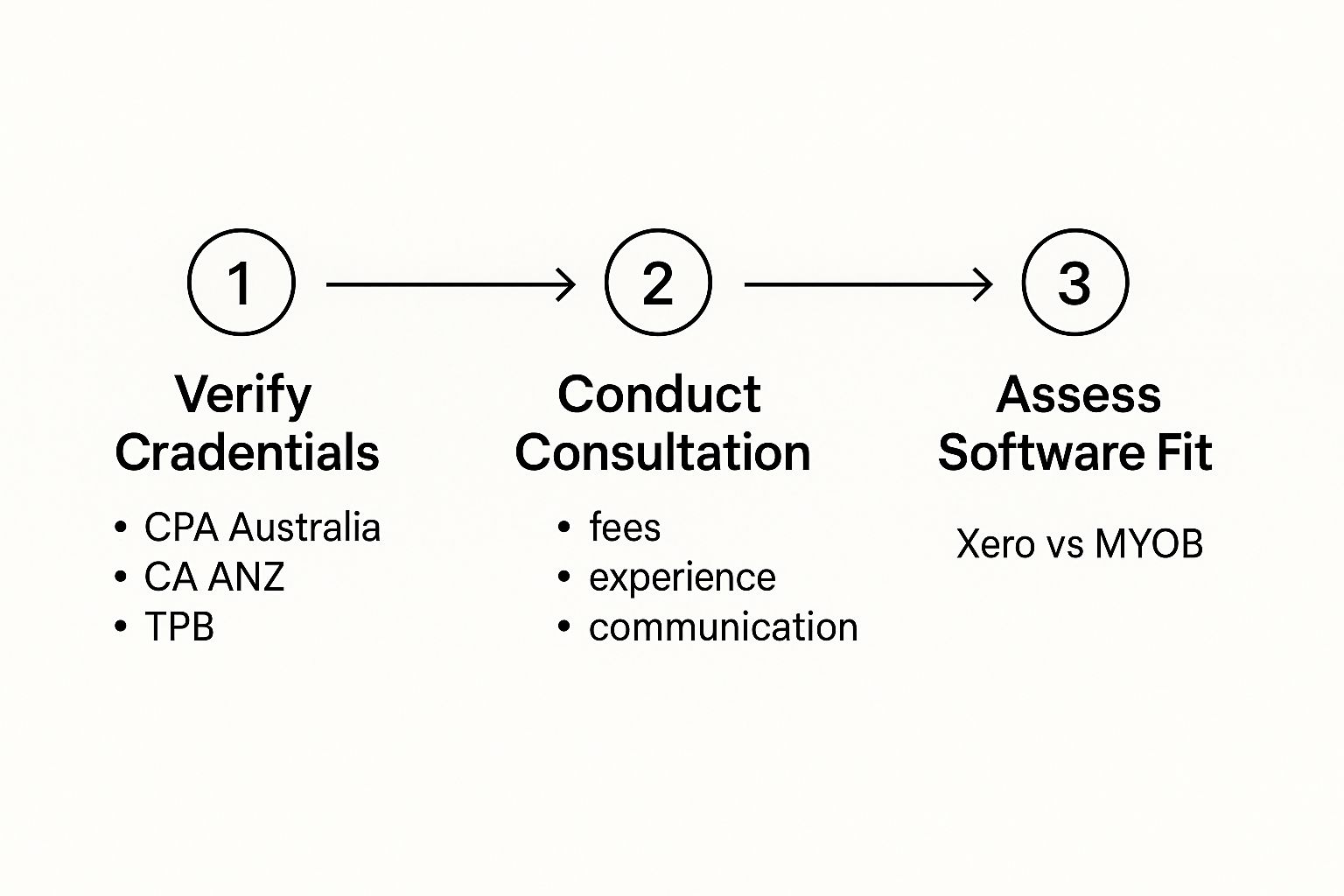
As you can see, once the credentials are confirmed, it's all about that initial meeting and making sure your tech stacks align.
Key Questions for Your Initial Consultation
That first meeting or call is your chance to see if you actually click. It’s a two-way street. You want to walk in prepared with a few questions that get right to the point for your Melbourne business.
Here are a few essentials to consider asking:
- Industry Experience: "What's your experience with businesses like mine? For example, cafes, e-commerce stores, or tradies?" An accountant who already gets the specific challenges and opportunities in your industry is worth their weight in gold.
- Communication Style: "Who will be my day-to-day contact, and what's your usual turnaround time for emails or calls?" This helps set expectations from the get-go, so you're not left hanging when you need an answer.
- Fee Structure: "How do you charge? Is it an hourly rate, or do you have fixed-fee packages? What’s actually included, and what costs extra?" Getting total clarity on costs upfront saves a lot of headaches and surprise bills down the track.
Remember, the goal here is to find someone who's not just a numbers guru but is also genuinely invested in your success. It’s as much about personality and vibe as it is about qualifications.
Finally, don't forget to talk tech. Ask them what accounting software they live and breathe. Most Melbourne firms are experts in platforms like Xero or MYOB. You need to ensure they’re pros on the system you use, or that they can help you move to something that better suits your business.
Making Your Final Decision and Onboarding

You’ve done the interviews, and now it’s time to make the call. This is about more than just qualifications on a piece of paper. You're looking for a partner, someone who gets what you’re trying to build and shows a real interest in your business's future.
Pay close attention to the 'soft skills'. A great accountant is proactive—they'll ask smart questions and challenge your thinking, not just wait for you to tell them what to do. This is a long-term professional relationship, so you need to feel confident they'll be a trusted guide, not just a number cruncher you hear from once a year.
Comparing Costs and Commitments
Fee structures can be all over the place, so getting clear on this is crucial. An hourly rate might seem appealing for small, one-off jobs, but a fixed-fee package usually gives you much better cost certainty for regular work like monthly BAS and reporting.
Always ask for a detailed breakdown of what’s included. You don't want to get hit with surprise bills every time you pick up the phone for a quick question.
Before you sign anything, they’ll send you an engagement letter. This is your contract, and it needs to spell everything out clearly:
- The exact scope of services being provided.
- The agreed fee structure and when payments are due.
- What you're responsible for, and what they're responsible for.
Take the time to read this document properly. It's the best tool you have for setting clear expectations right from the start and making sure everyone is on the same page.
Your Onboarding Checklist
Once you've given them the green light, a smooth onboarding process will help your new accountant hit the ground running. The faster they understand your business, the faster they can start adding real value.
Pull together the essential info they'll need. This usually includes access to your accounting software (like Xero or MYOB), previous tax returns and BAS statements, and your key business details like your ABN and TFN.
Having this organised means they can quickly get a handle on your financial history and current situation. It's also a good time to review how you pay yourself, as this is a critical piece of the puzzle. For a deeper dive, check out our complete guide on owner's drawings for a small business.
The Real Value an Accountant Adds to Your Business
It's a common and costly mistake to see your accountant as just another line item on your expense sheet. A good accountant isn't an expense at all—they're a genuine investment in the health, stability, and future of your business. Their job goes way beyond just keeping you on the right side of the ATO.
A skilled local accountant will save you countless hours of stress and confusion. More importantly, they provide the financial clarity you need to spot opportunities for growth and better profitability. They take all those complex numbers and turn them into a clear roadmap, helping you make smarter, more confident decisions. That kind of strategic guidance is absolutely vital for navigating Australia’s intricate financial landscape.
More Than Compliance—It's About Strategic Growth
The growing demand for high-level accounting services shows just how much this mindset is shifting. The Australian accounting services market hit a value of around USD 20.5 billion in 2024 and is on track for serious growth. This isn't just about filing tax returns; it's driven by businesses like yours needing precise, expert guidance to get ahead. You can dig into the numbers behind the growth of Australian accounting services on marknteladvisors.com.
At the end of the day, the best "accountant near me" becomes a crucial part of your team, offering the strategic advice needed to hit your long-term business goals.
An accountant’s true worth isn't just measured by the tax they help you manage, but by the opportunities they help you seize. They give you the financial confidence to build a stronger, more resilient business.
This partnership is key, and understanding the top reasons to work with a local tax accountant can really highlight the full impact they can have.
Got Questions About Finding an Accountant?
Even with a plan, a few questions always come up when you start searching for an "accountant near me." Getting these sorted early on means you can move forward with confidence, without any nasty surprises down the track. Let’s run through some of the most common ones we hear from Melbourne business owners.
One of the first things on everyone's mind is cost. It's a huge part of the decision, and honestly, the fees can vary quite a bit depending on exactly what you need.
How Much Does a Small Business Accountant Cost in Melbourne?
For a simple, one-off individual tax return, you might be looking at a few hundred dollars. But when it comes to ongoing business support—think BAS lodgements, payroll, and real strategic advice—many Melbourne firms work on fixed-fee monthly packages. These can range anywhere from $200 to over $1,000, all depending on the size and complexity of your business. The best thing you can do is ask for a detailed quote that spells out exactly what’s included. No ambiguity.
This naturally leads to another big question: should you go with a massive firm or a smaller local one?
Your choice between a large firm and a local one often comes down to balancing specialised services against personalised attention. Consider which is more valuable for your business right now.
A big accounting firm might have someone who specialises in a really obscure tax law, which is great if you have a complex setup. But on the flip side, a smaller local practice often gives you more dedicated, one-on-one time with an accountant who really gets to know you and your business. For most Melbourne sole traders and small businesses, a local firm hits that sweet spot between professional know-how and genuine partnership.
What Is the Difference Between a Bookkeeper and an Accountant?
Finally, it’s really important to get the roles straight. Think of it like this: a bookkeeper is focused on recording your day-to-day financial transactions. They’re the ones managing invoices, paying bills, and reconciling your bank accounts. Their job is to keep your financial records accurate and up-to-date.
An accountant then takes all that beautiful data and uses it for higher-level thinking. They prepare formal financial statements, handle tricky tax planning and lodgements, and give you strategic advice to help your business grow. While some accountants might offer bookkeeping, their main game is financial strategy and interpretation, not just data entry.
Ready to partner with a proactive Melbourne accountant who actually makes your business finances simple? At Genesis Hub, we offer clear, hands-on support to help you stay compliant and kick your goals. Book your free initial consultation to see how we can strengthen your business.