Calculating Australian payroll tax generally involves three key things: adding up your total taxable wages, checking your state's specific threshold and tax rate, and then doing the maths on the amount that goes over that threshold.
It’s a state-based tax, which is the most important thing to remember. The rules in one state can be wildly different from another, so where your business operates is a massive factor in getting this right.
Decoding Australian Payroll Tax
Before we jump into the numbers, it's important to have a solid handle on what payroll tax actually is and who has to pay it. This isn't a federal tax handled by the ATO like income tax or GST. Instead, it’s levied and managed by each individual state and territory government, and that one distinction is the source of most of the complexity.
A business in Sydney could have a completely different tax bill than one in Melbourne or Brisbane. It’s not just because the rates vary, but the thresholds—the wage amount you can pay before the tax even kicks in—are different, too.
What Are Taxable Wages?
One of the first hurdles everyone faces is figuring out what counts as 'taxable wages'. It's a much broader definition than you might think, going way beyond just regular salaries and hourly pay. Getting this wrong is a fast track to underpayments and potential penalties down the line.
Your total taxable wages will generally include:
- Salaries and Wages: This is the obvious one, covering your regular pay runs.
- Superannuation Contributions: Both the compulsory super guarantee payments and any extra employer contributions are usually included.
- Commissions and Bonuses: Any performance-based payments are considered part of your total wage bill.
- Allowances and Fringe Benefits: Payments for things like car or travel allowances almost always fall into the taxable bucket.
- Certain Contractor Payments: This is a notoriously tricky area. Depending on the contract's nature, payments to some contractors can be deemed wages for payroll tax purposes.
Important Note: This guide is for informational purposes only to help you understand the payroll tax calculation process. It is not financial or tax advice. You should always consult a qualified professional for guidance specific to your business situation.
Why State Thresholds Matter
The good news is you only start paying payroll tax once your total annual wage bill goes over a specific threshold set by your state or territory. For example, if a state's threshold is $1.2 million and your total annual wages are $1.5 million, you'd only calculate tax on the $300,000 that sits above that limit.
This threshold system is designed to shield smaller businesses from the tax, ensuring only those with larger payrolls need to pay it.
But for businesses operating across multiple states, it gets more complicated. Those thresholds have to be apportioned correctly, adding another layer to the calculation. Navigating these multi-state details is a key reason many business owners look into why every business needs an accountant—it ensures you stay compliant. Getting this foundation right is crucial before we move on to the practical steps of tallying your wages and applying the correct rates.
Identifying Your Total Taxable Wages
Before you can even think about calculating payroll tax, you need a rock-solid understanding of what makes up your total taxable wage bill. This figure is the absolute foundation of the whole calculation, and it’s a lot more than just the regular salaries you pay your team. Getting this number right isn't just important; it's non-negotiable for staying compliant.
Think of it like building a house. If the slab is wonky, everything that follows will be off. The same goes here. Every single piece, from bonuses and super to allowances, needs to be counted. Miss one small component, and your whole calculation will be wrong, which can lead to underpayments and the kind of attention from the state revenue office nobody wants.
What to Include in Your Wage Bill
When you start adding up your wages, you have to look at every single form of payment or benefit an employee gets. It's a surprisingly long list, and it often catches new business owners off guard.
Here’s a checklist of what you would typically need to include in your taxable wages:
- Salaries and regular pay: This is the easy one—your standard weekly, fortnightly, or monthly payments.
- Bonuses and commissions: Any performance-based payments are considered taxable wages, whether they're regular or just a one-off.
- Overtime and penalty rates: Those extra payments for working outside of standard hours? Yep, they’re fully included.
- Allowances: Payments for things like car, travel, or uniform allowances are usually taxable, although there can be some specific exemptions.
- Director fees: Any money paid to company directors, including non-executive directors, is part of the wage bill.
- Superannuation contributions: This covers the compulsory Superannuation Guarantee (SG) payments and any extra employer contributions, like salary sacrifice amounts.
- Fringe benefits: You’ll need to include the grossed-up taxable value of any fringe benefits you provide to your staff.
A classic mistake often seen is business owners leaving out superannuation. They might treat it as a separate expense in their books, but for payroll tax, it's typically part of the taxable wage calculation.
The Grey Area of Contractor Payments
Here’s where things can get really tricky. One of the toughest parts of figuring out your wage bill is dealing with payments to contractors. Not all contractors are exempt, and the state revenue offices have very specific rules to work out if a contractor is essentially an employee for tax purposes.
As a general rule, your payments to a contractor might be deemed taxable wages if their contract is mostly for their labour. For instance, if you hire a freelance graphic designer for a one-off project and they use their own gear and work for other clients, their payments are probably exempt. But, if you hire a consultant who works only for you, in your office, using your computer—the revenue office will likely see those payments as taxable wages.
Getting this distinction right is crucial. Incorrectly excluding contractor payments is a massive red flag for auditors. If you're even slightly unsure, getting professional advice is a prudent course of action. Trying to navigate how small business owners can navigate tax season on your own can be a real minefield.
Understanding Grouping Provisions
Another concept you need to be aware of is grouping. If you own or control more than one business, the state revenue office might 'group' them together for payroll tax. This means the wages from all businesses in the group get added together to see if you’ve gone over the tax-free threshold.
Let’s look at a quick example. Imagine you own two separate companies:
- Company A: Has annual wages of $800,000
- Company B: Has annual wages of $500,000
On their own, neither company might hit a state's threshold (let's use NSW's $1.2 million threshold). But if they're grouped, their combined wages shoot up to $1.3 million. Suddenly, the group is over the threshold, and you could be on the hook for payroll tax on the amount above it.
Grouping can be triggered by all sorts of things, like having common directors, sharing employees, or financial links between the businesses. The rule is there to stop people from splitting their operations into smaller companies just to avoid paying payroll tax. Ignoring these provisions can land you with a surprise tax bill and hefty penalties, so take a very close look at your business structure.
Navigating State and Territory Thresholds and Rates
So, you've tallied up your total taxable wages. The next hurdle—and it’s a big one—is figuring out the specific rules for the state or territory you operate in. This is where so many businesses get tripped up, especially those with staff spread across the country.
Australia’s payroll tax system isn't one clean, national framework. It's a patchwork of state and territory regulations, each with its own tax-free threshold and specific tax rate. What this means in practice is that a business in Perth could face a completely different tax bill than an identical business in Adelaide, even with the exact same wage costs. These aren't just minor differences; they can seriously impact your bottom line.
This visual breaks down what goes into your total taxable wages—the essential starting point for any payroll tax calculation.
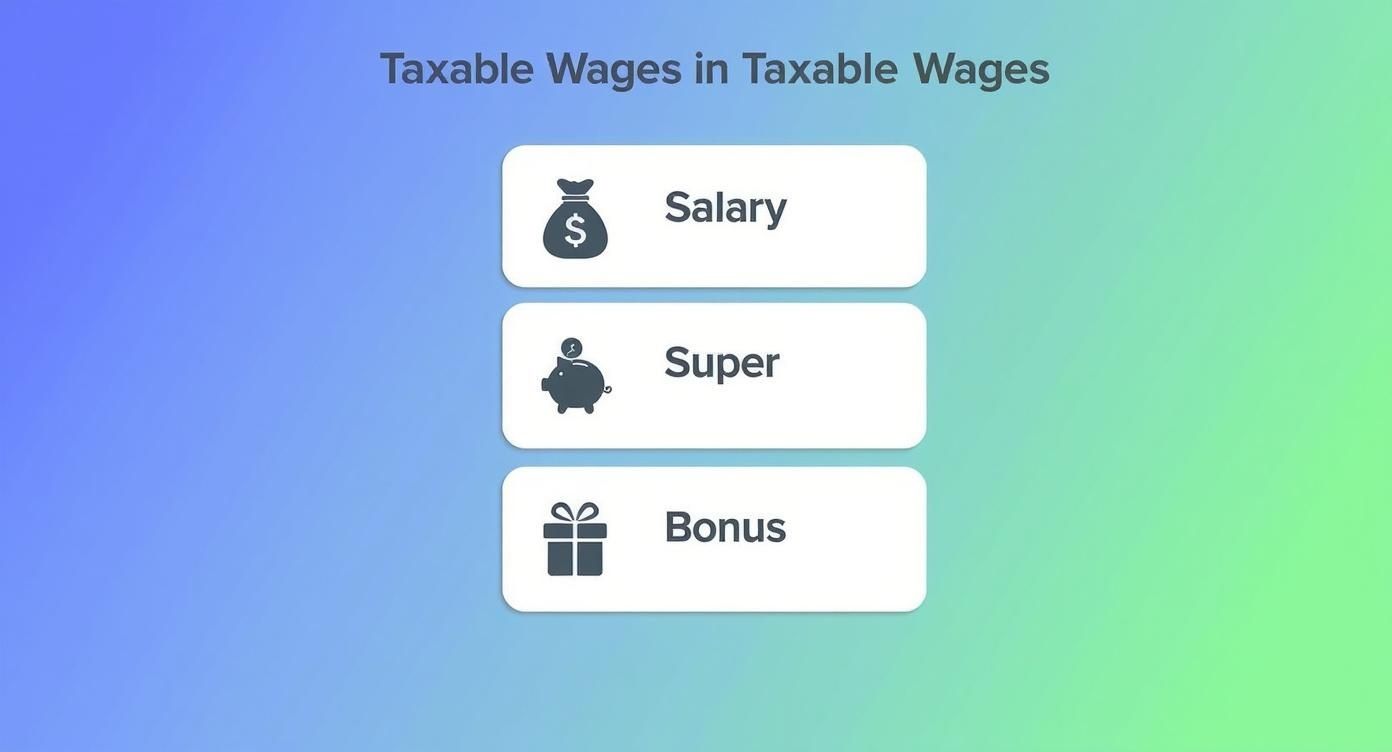
As you can see, you can’t just stop at base salaries. To get your true wage total, you typically must include things like superannuation contributions and bonuses.
Understanding Thresholds: The Gatekeeper of Payroll Tax
The payroll tax-free threshold is the single most important number you need to know for your state. Think of it as the annual wage amount your business can pay out before you're on the hook for tax. If your total annual wages fall below this number, you generally don’t have to pay a cent.
But what happens when you go over? The good news is you only pay tax on the portion of wages that is above the threshold. For example, if the threshold is $1,000,000 and your wage bill hits $1,100,000, your tax is calculated only on that $100,000 difference, not the full amount.
This system is deliberately designed to shield small and medium-sized businesses from the tax burden, making sure only larger employers are contributing.
A Look at How Rates and Thresholds Differ Across Australia
Let's get into the nitty-gritty. The tax-free threshold varies quite a bit depending on where you are. In New South Wales for the 2025-26 financial year, the threshold is $1,200,000 per year. Any wages above that are taxed at 5.45%.
Hop over to Victoria, and the threshold is a bit lower at $1,000,000. However, the tax rate is 4.85% for most employers and drops to a tiny 1.2125% for regional businesses—a massive incentive to operate outside the major cities. Over in Western Australia, the threshold is $1,000,000 with a 5.5% rate, while the Northern Territory offers a more generous $1,500,000 threshold. For the most up-to-date figures, it's always a good idea to check official sources like the Revenue NSW website.
These examples show why a "one-size-fits-all" approach to payroll tax just doesn't work in Australia. A business in Victoria might start paying tax sooner than one in NSW but could benefit from a lower rate, particularly if it's based regionally.
Key Takeaway: Don't assume the rules are the same everywhere. Always verify the current threshold and rate for the specific state or territory you're in. These figures are often updated, and what was true last financial year might not be true this year.
Australian Payroll Tax Thresholds and Rates at a Glance
To really make sense of how these differences play out, it helps to see the numbers side-by-side. The variations can be pretty stark and often influence major business decisions, from where you hire to where you set up shop. This table gives you a quick snapshot of the standard thresholds and rates across Australia, providing a handy reference point.
| State/Territory | Annual Threshold | Standard Tax Rate (%) |
|---|---|---|
| Australian Capital Territory | $2,000,000 | 6.85% |
| New South Wales | $1,200,000 | 5.45% |
| Northern Territory | $1,500,000 | 5.50% |
| Queensland | $1,300,000 | 4.75% (for wages up to $6.5M) |
| South Australia | $1,500,000 | Variable up to 4.95% |
| Tasmania | $2,000,000 | 6.10% (4% for wages < $2M) |
| Victoria | $1,000,000 | 4.85% (1.2125% for regional) |
| Western Australia | $1,000,000 | 5.50% |
A word of caution: these figures can change and might not include all levies or surcharges. Make sure to check with the relevant state revenue office for the most current information.
Seeing it all laid out like this really highlights the complexity. For instance:
- New South Wales (NSW): Has a fairly high threshold and a single, straightforward tax rate, which simplifies calculations a bit for NSW-based businesses.
- Victoria (VIC): Offers significant rate discounts for regional employers, a clear policy aimed at boosting business growth outside of Melbourne.
- Queensland (QLD): Also has a high threshold that helps many SMEs, but it adds a mental health levy for very large employers, giving bigger companies another layer to think about.
- South Australia (SA): Uses a tapered system where the tax rate climbs as the payroll grows, which is a different model altogether.
Calculating Your Payroll Tax Liability
Alright, let's get down to the practical side of things—turning all those rates and thresholds into an actual dollar figure. The best way to really get your head around payroll tax is to see it in action with some real-world examples. It’s less about complicated maths and more about following a clear, logical process.
At its heart, the formula is pretty simple: you take your total taxable wages, subtract the tax-free threshold for your state, and then multiply what's left by the correct tax rate.
But, as with most things tax-related, the devil is in the detail. A business operating entirely within one state has a much simpler calculation than a national company with staff spread across the country. We’ll walk through both scenarios so you can see exactly how it’s done.
Example 1: The Single-State Business
Let's start with the most common situation: a business that operates solely within one state. For our example, we'll imagine a Sydney-based marketing agency, "Sydney Digital Creatives," that only employs people in New South Wales.
Here are the numbers we're working with:
- Total Annual Taxable Wages: $1,500,000
- State of Operation: New South Wales (NSW)
- NSW Annual Threshold: $1,200,000
- NSW Payroll Tax Rate: 5.45%
The calculation itself is straightforward. First, you figure out the portion of your wages that is actually subject to tax. You do this by subtracting the threshold from your total wage bill.
$1,500,000 (Total Wages) - $1,200,000 (NSW Threshold) = $300,000 (Taxable Amount)
Next, you just apply the NSW tax rate to that taxable amount to find your total payroll tax liability for the year.
$300,000 (Taxable Amount) x 5.45% (NSW Rate) = $16,350
So, for the financial year, Sydney Digital Creatives would owe $16,350 in payroll tax. This amount is usually paid to Revenue NSW in monthly instalments, followed by an annual reconciliation to square everything up.
A Quick Reminder: This walkthrough is purely for educational purposes to show you the mechanics. It is not tax advice. Your unique business situation will always determine your actual liability, and you should consult a professional.
Example 2: The Multi-State Business
Now for a more complex scenario that’s very common for growing businesses: operating across multiple states. This is where things get a bit trickier, as you need to correctly apportion your tax-free threshold. You don't get the full threshold in each state; instead, it's divided up based on where your wages are paid.
Let's use a national retail company, "Aus-Wide Retail," with staff in both Victoria and Queensland.
Here are their figures:
- Total Australia-Wide Wages: $2,500,000
- Wages Paid in Victoria (VIC): $1,500,000
- Wages Paid in Queensland (QLD): $1,000,000
- VIC Annual Threshold: $1,000,000
- QLD Annual Threshold: $1,300,000
Because Aus-Wide Retail's total Australian wages ($2.5 million) are above both state thresholds, they need to calculate their tax liability in each state separately. Since payroll tax is a state-based levy, not a federal one, the rules can vary significantly depending on where you operate. For example, the Australian Capital Territory has its own unique system. You can get more details on ACT's payroll tax from their official site.
The first step is to work out the deductible threshold amount for each state. This is done by calculating the proportion of wages paid in that state compared to the national total.
1. Victoria Calculation
- Proportion of VIC Wages:
$1,500,000 / $2,500,000 = 0.6(or 60%) - Apportioned VIC Threshold:
$1,000,000 (Full VIC Threshold) x 0.6 = $600,000 - VIC Taxable Amount:
$1,500,000 (VIC Wages) - $600,000 = $900,000 - VIC Payroll Tax (at 4.85%):
$900,000 x 0.0485 = $43,650
2. Queensland Calculation
- Proportion of QLD Wages:
$1,000,000 / $2,500,000 = 0.4(or 40%) - Apportioned QLD Threshold:
$1,300,000 (Full QLD Threshold) x 0.4 = $520,000 - QLD Taxable Amount:
$1,000,000 (QLD Wages) - $520,000 = $480,000 - QLD Payroll Tax (at 4.75%):
$480,000 x 0.0475 = $22,800
In this case, Aus-Wide Retail’s total payroll tax liability for the year comes to $66,450 ($43,650 for Victoria + $22,800 for Queensland). Following this multi-step process is vital for staying compliant and avoiding the common mistake of claiming the full threshold in more than one state.
Handling Surcharges and Complex State Rules
Just when you think you’ve got the hang of the standard calculation, some states throw in extra layers that can really complicate things. These aren't just minor tweaks; they’re specific surcharges and unique rules that mostly hit larger businesses. If you overlook them, you could be left with a serious compliance headache.
Getting your head around these nuances is the only way to accurately forecast your tax bill. It stops you from getting a nasty surprise when your final liability is higher than expected, all because of a surcharge you didn't even know existed. A set-and-forget approach to payroll tax can be risky.
Victoria's Surcharge System Explained
Victoria is a perfect example of a state that adds this extra complexity for large employers. These levies are tacked on top of the standard payroll tax, aimed at businesses with a hefty national payroll. For any large company operating in the state, this is a massive detail to get right.
There are a couple of key surcharges you should be aware of in Victoria:
- The Mental Health and Wellbeing Surcharge: This kicks in for businesses once their national wages cross a certain threshold.
- The COVID-19 Debt Surcharge: In a similar vein, this one is also levied on large employers to help the state pay down its pandemic-related debt.
Since each state and territory runs its own payroll tax system, efforts to create a standard, nationwide approach have gone nowhere. This leaves national employers trying to navigate a patchwork of different rules.
Beyond the basic rates, states like Victoria add surcharges for bigger companies. For instance, if your national payroll is over $10 million, you’ll also be hit with a mental health and wellbeing surcharge and a COVID-19 debt surcharge. These can add another 1% to your bill (or 2% if your payroll is over $100 million) on the Victorian portion of your wages, making the final calculation that much trickier. You can find more detail on how these state-specific levies work by exploring these payroll tax insights.
This means for larger Victorian employers, just applying the standard tax rate isn't going to cut it. You have to first check if your national payroll breaches the surcharge thresholds, and then apply the extra percentage to your Victorian wages.
When Calculation Methods Differ
The complexity doesn't stop with surcharges. States also have different ways of structuring their tax rates, which completely changes how you calculate your liability. While some states like New South Wales keep it simple with a single, flat-rate system, others use more dynamic models.
South Australia, for example, uses a tapered rate system. This is a more complex approach where the tax rate you pay gradually increases as your total payroll grows, right up to a maximum percentage.
What is a Tapered Rate?
Instead of one flat rate for everyone over the threshold, a tapered system means your effective tax rate changes with your wage bill. A business with a $1.6 million payroll might pay a lower rate than one with a $3 million payroll. This requires a much more detailed calculation than simple multiplication.
This is a world away from a flat-rate system where every dollar over the threshold gets taxed at the exact same percentage. If you operate in South Australia, you can't just pluck a single number out of the air; you have to use a specific formula from RevenueSA to figure out your correct rate first.
These variations really drive home why you must treat each state as its own separate world for payroll tax. Assuming one state’s rules apply everywhere else is a common and very costly mistake. Staying on top of these intricate details is non-negotiable for any business that’s serious about compliance. You can explore more articles on our Tax and Compliance hub to stay updated.
Common Questions About Calculating Payroll Tax
Even after breaking it down, it's completely normal to have a few lingering questions about the finer points of calculating payroll tax. It’s a complex area, and certain scenarios pop up again and again, causing headaches for business owners. Getting clear answers is the key to staying compliant and avoiding simple, costly mistakes.
This section covers some of the most common payroll tax questions.
When Do I Need to Register for Payroll Tax?
This is easily one of the most common questions. You are legally required to register for payroll tax once your total Australian wages go over the monthly threshold for your state or territory.
Registration isn't optional. It has to be done within seven days of the end of the month in which your wages first crossed that line.
For example, if your state's monthly threshold is $100,000 and your wage bill for October creeps up to $105,000, you would need to register with your state's revenue office by the 7th of November. Keeping a close eye on your wage bill each month is crucial so you don't get caught out.
Are Payments to All My Contractors Taxable?
Not always, but this is a massive grey area and a common trap. Payments to genuine independent contractors are usually exempt. However, state revenue offices scrutinise these arrangements very closely to make sure they aren't just disguised employment relationships.
Payments to a contractor might be deemed taxable if the contract is mainly for their labour. Some big red flags include:
- The contractor works exclusively for your business.
- They are paid by the hour or day, rather than for a specific result or project.
- You supply the equipment and tools for their work.
If your contractor relationships tick these boxes, there's a good chance their payments need to be included in your taxable wages.
One of the biggest mistakes business owners make is forgetting to include superannuation contributions in their total wage bill. For payroll tax purposes, super is almost always considered part of taxable wages.
What Happens if My Business Operates Across Multiple States?
Running a business nationally brings a critical rule into play: you can’t claim the full tax-free threshold in each state. This is a fast track to underpayment and penalties if you get it wrong.
Instead, you have to split the threshold. You calculate a deduction in each state based on the proportion of your wages paid there compared to your total national wages.
It’s a common pitfall for expanding businesses, as is forgetting about the grouping provisions. These rules combine the wages of related companies. If your businesses are controlled by the same people or are financially linked, their wages get added together. This can easily push you over the threshold when you thought you were in the clear.
Navigating payroll tax, from figuring out taxable wages to handling multi-state rules, can be a huge drain on your time. At Genesis Hub, we make it simple. Our team provides proactive payroll and tax management, ensuring you stay compliant and avoid costly errors. We handle the complexities so you can focus on growing your business with confidence. Find out how we can help by visiting our website.