That first leap into self-employment is an incredible feeling. But then tax time rolls around, and lodging your first self employed tax return can feel like hitting a brick wall.
If you’re a sole trader in Australia, the process is a world away from a standard employee return. It’s all about business income, allowable deductions, and most importantly, diligent record-keeping. The biggest shift is mental—you have to start thinking like a business owner, not an employee, from day one.
This article provides general information and a guide to navigating the process. It is not intended as financial or tax advice. You should consult with a qualified professional for advice tailored to your specific circumstances.
Your First Self Employed Tax Return Explained
When you move from being a PAYG (Pay As You Go) employee to a sole trader, the way you handle your money and report to the Australian Taxation Office (ATO) completely changes.
As an employee, your employer would typically withhold tax from each payslip. Now, you’re getting paid your gross business income, and it's up to you to manage your funds and plan for your future tax obligations.
This shift puts all the responsibility squarely on your shoulders. You’re running a business, even if it's just you. That means you need to track every single dollar coming in and every eligible expense going out. Good financial habits aren't just a nice-to-have; they're absolutely essential for getting through tax season without a major headache.
Key Concepts for Sole Traders
Before you even think about lodging, there are a few core ideas to understand. Familiarising yourself with these concepts can make the whole process much less confusing.
- Assessable Income: This is a term for your gross income—every dollar you earn from your business activities before you take out any expenses. This could include client payments, consulting fees, and more.
- Allowable Deductions: These are business-related expenses that may be claimed to lower your taxable income. The ATO's golden rule here is simple: the expense must be directly linked to earning your income.
- Record-Keeping: This one is non-negotiable. The ATO requires you to keep records of all your income and expenses for at least five years. That means holding onto invoices, bank statements, and every single receipt for any deduction you claim.
The self-employed workforce in Australia is a huge and growing part of our economy. This boom really highlights why it’s so important to get a grip on the unique tax landscape that comes with being your own boss.
The move to self-employment is definitely becoming more mainstream. In fact, recent data showed that over 2.3 million Australians now identify as self-employed, which is a massive slice of the national workforce. This trend just proves how vital clear, practical guidance is. For some extra pointers, have a look at our guide on how small business owners and individuals can navigate tax season.
Organising Your Financial Paperwork for Tax Time
Let's be honest, a smooth tax return is built on a foundation of organised records. Getting your financial paperwork in order isn’t just some chore you tackle at the end of the year; it's a habit that saves you from that frantic scramble when the 31 October deadline starts looming.
Think of it as setting up your business's financial command centre. The real goal here is to create a simple, reliable system where every dollar coming in and every dollar going out is accounted for. This sort of preparation is what turns tax time from a massive headache into a straightforward process.
The Essential Document Checklist
Before logging into myTax, it is important to round up all the key financial documents from the last financial year. A disorganised pile of receipts and invoices can lead to missed deductions and a whole lot of frustration.
Here's the core paperwork you'll want to have on hand:
- All Income Statements: This covers everything from invoices you've sent to clients to payment summaries from any platforms you work through. You need the complete picture of your gross business income.
- Business Bank Account Statements: A dedicated business account is a useful tool. Its statements give you a clean, chronological record of all your business transactions, neatly separating them from your personal spending.
- Expense Receipts and Invoices: This is where the magic happens. You need proof for every single deduction you plan to claim. We're talking software subscriptions, office supplies, fuel, client lunches—the lot.
- Asset Purchase Records: Bought a new laptop, camera, or specialised tools for your trade? Keep those receipts separate. These bigger purchases are often treated differently from your day-to-day running costs.
A classic pitfall for new sole traders is mixing business and personal finances. By setting up and using a separate business bank account from day one, you create an automatic, clean audit trail that makes sorting your income and expenses incredibly simple.
Creating a Year-Round System
The real secret to a painless tax return is dodging that last-minute panic. A highly effective strategy is to implement a simple, year-round system for keeping your records straight.
For example, a freelance writer might have a digital folder system on their computer, organised by month. Inside each monthly folder, they could have sub-folders for 'Client Invoices' and 'Expense Receipts'. After paying for a software subscription, they immediately save the PDF invoice into the right folder. It takes less than a minute.
On the other hand, a tradie who buys materials almost daily could use a receipt-scanning app on their phone. They can snap a photo of the receipt from the hardware store right after the purchase, tag it as 'Materials', and the app will digitise and store it securely. No more faded, lost, or crumpled receipts.
By picking up a simple habit—whether it's digital or physical—you ensure that when it's time to prepare your self-employed tax return, 90% of the work is already done.
Maximizing Your Business Tax Deductions
Knowing what may be claimable on your self-employed tax return is an absolute game-changer. This isn't about sneaky loopholes; it’s about claiming legitimate business costs so you only pay tax on your actual profit. Every single valid deduction you make chips away at your taxable income, which can make a huge difference to your final tax bill.
When it comes to deductions, the Australian Taxation Office (ATO) has two golden rules that apply to everything. First, the expense must be for your business, not for personal use. Second, you must have a record to prove it. If you can confidently tick both those boxes, you're on the right track.
Common Deductions Sole Traders Often Miss
So many sole traders leave money on the table simply because they aren’t aware of everything they may be entitled to claim. Let's break down some of the most common—and often missed—categories.
One of the biggest is home office expenses. If you work from home, a portion of your household running costs may be claimable. This includes things like electricity, gas for heating, your phone and internet bills, and even the decline in value of your desk and chair. You can use the ATO's fixed-rate method or calculate the actual costs based on your dedicated work area.
Another huge one is vehicle and travel costs. If you use your car for work—think a photographer driving to a shoot or a consultant visiting a client—you may be able to claim those running costs. This can be done by meticulously tracking your business-use percentage with a logbook or, for simpler cases, using the cents per kilometre method for up to 5,000 business kilometres.
This infographic neatly summarises the key areas to focus on.
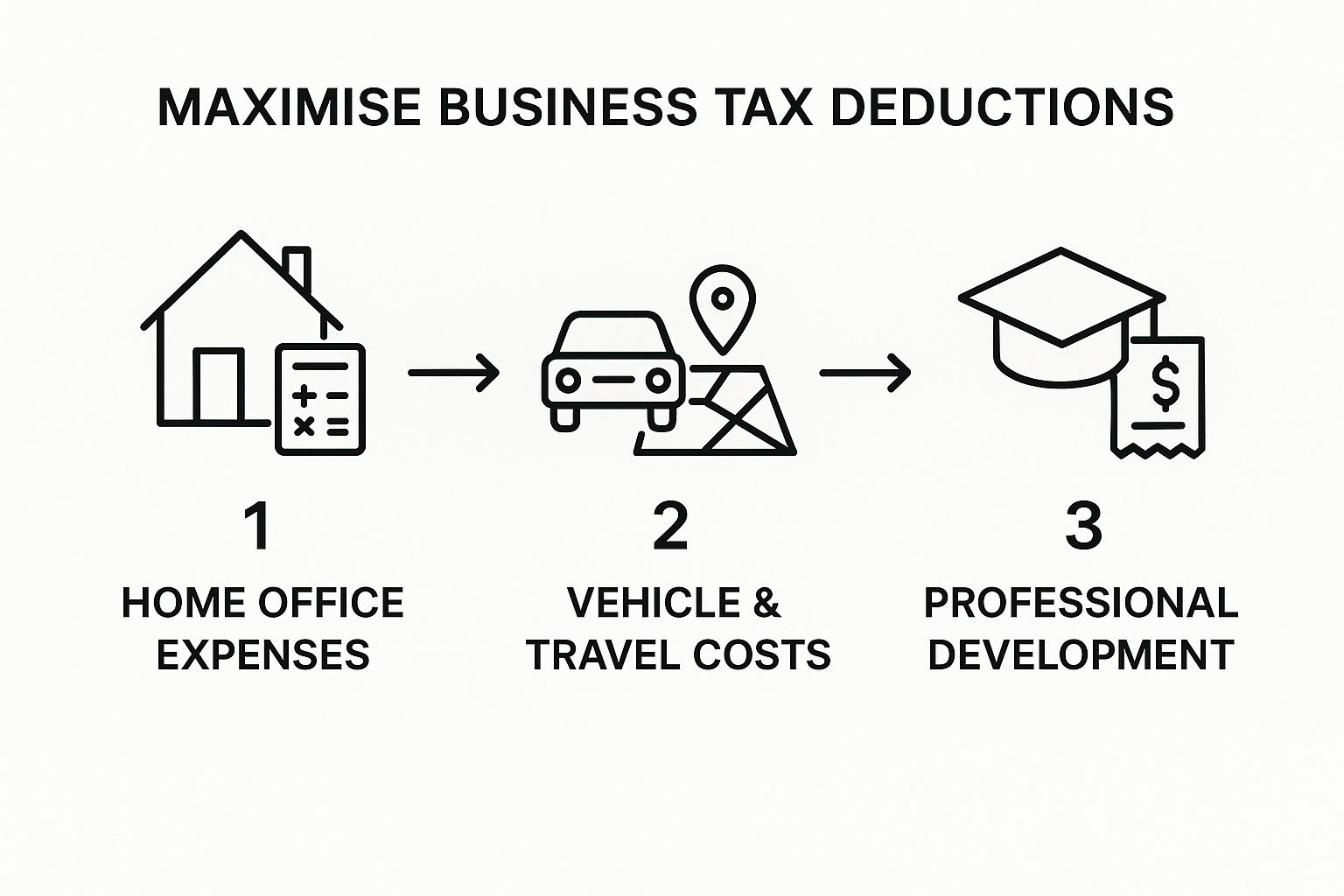
As you can see, a systematic approach to tracking your home office, vehicle, and professional development expenses is the bedrock of a solid deductions strategy.
To help clear things up, here’s a quick look at what typically gets the green light from the ATO and what doesn't.
Common Business Expense Claims for Sole Traders
| Expense Category | Generally Claimable Example (Business Portion) | Generally Not Claimable Example |
|---|---|---|
| Home Office | A percentage of your internet and electricity bills based on work use. | The full cost of your mortgage or rent. |
| Vehicle | Fuel, insurance, and servicing costs based on your logbook percentage. | The cost of your normal daily commute from home to your primary workplace. |
| Tools & Equipment | The cost of a new laptop used primarily for business. | A new TV for the living room, even if you sometimes watch work-related shows. |
| Professional Development | Fees for a course that upgrades your skills in your current role. | A degree for a completely new career path. |
| Travel | Flights and accommodation for an interstate industry conference. | A family holiday with a few hours of work thrown in. |
This table is just a starting point and provides general examples. It is important to check the ATO guidelines for the specific rules that apply to your situation.
Expanding Your Claimable Expenses
Beyond the home office and the car, there's a whole world of other costs directly tied to running your business that you may be able to claim. Just think about the money you spend to find and keep your clients.
- Marketing and Advertising: The cost of running social media ads, printing business cards, or maintaining your website could be claimable.
- Professional Development: Did you take a course to upskill, attend an industry conference, or subscribe to a trade journal? If it's directly linked to your current work and improving your skills, it's generally deductible.
- Insurance and Fees: Premiums for public liability or professional indemnity insurance are common deductions. The same goes for bank fees on your business account and any fees for accounting or legal advice.
The core principle is pretty straightforward: if you spent the money to help earn your assessable income, it’s likely a valid business deduction. The ATO just needs you to be able to connect the dots between the expense and your business operations.
For the 2024-2025 financial year, the ATO is really hammering home the importance of diligent record-keeping for every single deduction. With tax rates changing, understanding every eligible expense is a critical part of managing your overall tax liability.
Just remember that some expenses, like the money you pay yourself, are not a business deduction. You can learn more by checking out our guide on owner's drawings for small businesses.
A Practical Walkthrough of Lodging with myTax
Lodging your first self employed tax return can feel like a pretty big hurdle, but the ATO’s myTax portal is built to make it as painless as possible. This is the online system you’ll access through your myGov account, and it’s where all that careful record-keeping finally meets the official submission process.
Once you’ve linked the ATO to your myGov account, you're ready to get started.
The system is surprisingly intuitive. It often pre-fills information it already has from places like employers or banks. But as a sole trader, the real work starts when you have to manually enter your own business income and expenses. The key is to just take it one section at a time.
The platform gets you to customise your return by ticking boxes for the income and deductions that apply to you. For any sole trader, the most important one to tick is 'You were a sole trader or had business income or loss'.
This screenshot gives you a look at the myTax landing page, which is your starting point. The clean layout and direct prompts are there to guide you through the process logically.
Navigating the Business Income Section
After customising your return, myTax will direct you to the 'Business/sole trader income or loss' section. This is really the heart of your self employed tax return—it’s where you’ll punch in the numbers you’ve been meticulously tracking all year. Don't let the fields intimidate you; they line up directly with the records you’ve already organised.
First up, you’ll need to enter your Main business activity and your Australian Business Number (ABN). The system then asks for your total business income.
- Gross payments including GST: This is your total turnover—every single dollar your business brought in before you take out any expenses.
- Other business income: This field is for any extra income related to your business that wasn't from your main sales. Think government grants or maybe an insurance payout.
More and more Aussies are getting the confidence to lodge themselves. ATO stats showed that of the 6.4 million individual tax returns lodged by August 2025, over 3.5 million were self-prepared. It just highlights how many people are now comfortable managing their own tax affairs. You can dig into these lodgement trends on the ATO's official statistics page.
Entering Your Business Expenses
Right below the income section, you'll find all the expense categories. This is where your diligent record-keeping really pays off, allowing you to plug your totals into the right fields with confidence.
The categories are quite specific, which actually makes it easier to classify your costs correctly:
- Cost of sales: These are the direct costs tied to providing your goods or services.
- Contractor, sub-contractor and commission expenses: Any payments you've made to other businesses or individuals for their services.
- Motor vehicle expenses: Here’s where you’ll enter the amount you calculated, whether you used a logbook or the cents-per-kilometre method.
- All other expenses: This is the catch-all category for everything else—from home office costs and software subscriptions to your professional insurance.
It’s absolutely critical to report your total gross income first, and then list your deductions. Never just enter your net profit figure. The myTax system is designed to calculate your profit based on the separate income and expense figures you provide.
Demystifying Personal Services Income
Finally, the myTax portal will ask you a few questions to figure out if you earned Personal Services Income (PSI). This is income that’s produced mainly from your personal skills or efforts as an individual, not from selling goods or using assets.
The PSI rules exist to ensure that individuals who are essentially working like employees do not gain access to business tax deductions that would not otherwise be available. For a lot of freelancers, consultants, and contractors, their income may be considered PSI.
If the rules apply to you, you might be limited in the kinds of deductions you can claim. The good news is that the myTax portal has a built-in tool that walks you through a series of questions to determine if your income falls under these rules. It’s crucial to answer these questions honestly to make sure your return is compliant.
What Happens After You Hit ‘Lodge’?
That feeling of hitting ‘submit’ on your tax return is a huge relief, but you're not quite at the finish line yet. The next step is a bit of a waiting game while the Australian Taxation Office (ATO) does its thing. The good news is you’re not left completely in the dark.
You can actually keep an eye on your return's progress right from your myGov account. Just log in, head over to the ATO section, and you’ll see a status tracker. It's a handy little tool that shows you exactly where your return is at, moving from 'processing' right through to 'issued'.
Getting Your Notice of Assessment
Once the ATO has finalised everything, a very important document called a Notice of Assessment (NOA) will land in your myGov inbox. This is the ATO's official summary of your tax outcome, and it's something you need to check carefully.
The NOA spells out the final calculation. It’ll tell you straight up if you’re getting a refund, if you have a tax bill to pay, or if you've landed on a nil balance. The first thing you should do is compare the figures on the NOA with the estimate you got when you lodged. Do they match up?
Think of your Notice of Assessment as the official report card for your tax return. Don't just file it away and forget it. Pull up your own records and make sure the income, deductions, and final figure all match what you submitted.
If you spot something that doesn't look right or you think there's been a mistake, it's best to sort it out sooner rather than later.
What to Do If You Have a Tax Bill
Getting a tax bill instead of a refund can sting a bit, but for sole traders, it’s not unusual. The NOA will clearly state how much you owe and the payment due date. The ATO gives you plenty of ways to pay, like BPAY, credit/debit card, or setting up a direct debit.
If you look at the amount and know you'll struggle to pay it all by the due date, don't panic and definitely don't ignore it. The ATO is usually pretty reasonable about setting up payment plans, which let you chip away at the debt in smaller, more manageable instalments. The key is to be proactive—get in touch with them and explain your situation.
And finally, just because your return is lodged doesn't mean you can toss out all that paperwork. You are legally required to hang onto all your business records—invoices, receipts, the lot—for at least five years from the date you lodged. This is your backup in the rare case the ATO comes knocking with any follow-up questions.
Common Tax Questions for Sole Traders
Even with the best plan in place, wading through your first few self-employed tax returns will probably throw up some curly questions. It's completely normal. Getting your head around these common queries will help you feel more confident that you're ticking all the right boxes.
One of the first hurdles for many sole traders is GST. Do you need to register? The simple answer is you’re only required to register for Goods and Services Tax (GST) once your annual business turnover hits $75,000. If you're earning less than that, registration is optional. If you do register, you must start adding GST to your prices, and you can also claim credits for the GST you pay on business purchases.
Another big one we see all the time is the sheer chaos of managing receipts.
Keeping Track of Your Records
Forget the shoebox full of faded dockets. A sustainable way to manage your records is to go digital. Opening a dedicated business bank account can create a clean, separate history of your transactions.
Then, build a simple habit: every time you get a receipt, snap a photo of it on your phone immediately. Save it to a cloud folder (like Google Drive or Dropbox) and organise it by month. This tiny action can prevent lost or unreadable receipts from costing you real money in missed deductions.
The most common points of failure for sole traders at tax time are often small, preventable habits. A simple, consistent digital filing system for receipts can be the difference between a smooth lodgement and a stressful, chaotic scramble.
If the idea of managing all this yourself is already giving you a headache, professional help might be the answer. Our guide explains why every business needs an accountant and can give you some valuable perspective.
Managing Deadlines and Setup Costs
Okay, so what happens if life gets in the way and you miss the deadline? If you're lodging your own return, the cut-off is typically 31 October. If you miss it, the ATO can apply a 'failure to lodge on time' penalty, which may increase the longer you leave it.
And a final, but very important question: what about all the money you spent before you even made your first dollar?
- Can you claim pre-business costs? Certain initial setup costs may be claimable. This can include things like professional advice on structuring your business or any government fees you had to pay.
- How are they claimed? These are not always a one-off deduction in your first year. The ATO generally requires these costs to be deducted over a five-year period.
- What’s the catch? You guessed it: records. Meticulous record-keeping is non-negotiable here. You need solid proof for every single expense you want to claim from before your business was officially up and running.
Feeling confident about your next tax return is powerful. At Genesis Hub, we partner with sole traders to make tax simple and your business stronger. Book a free consultation today and let's get you prepared.