If your boss asks you to temporarily pack your bags for a project in another city, who foots the bill for your extra living costs? That’s where the working away from home allowance comes in.
It's a special payment from your employer to cover the additional expenses—think accommodation, food, and utilities—that pop up when you have to live away from home for your job. This isn't a pay rise or a simple reimbursement; it's designed specifically to ensure you aren't left out of pocket for work-related travel.
Demystifying the Working Away From Home Allowance
Let's paint a picture. Your company sends you to manage a project in Perth for three months. Meanwhile, your mortgage, bills, and family life are still ticking along back in Melbourne. Suddenly, you're paying for two sets of living costs. This is the exact financial gap the allowance is meant to fill.
Think of it this way: your salary pays for your normal life. The working away from home allowance covers the extra life you’re temporarily leading for your job.
This is a crucial point. It’s an estimated payment to cover those reasonable, additional expenses, not a dollar-for-dollar refund for every coffee and meal you buy.
Key Concepts You Need to Know
Before we go any further, there are a couple of core ideas to understand. These terms are what the Australian Taxation Office (ATO) uses to draw the line on what qualifies as "working away from home."
- Usual Place of Residence: This is your permanent home base. It’s where you normally live, where your personal and family ties are, and the place you fully intend to return to once the temporary gig is over.
- Temporary Workplace: This is the job site you’re assigned to for a relatively short, defined period. The keyword here is "temporary." If the role starts to look indefinite or permanent, the whole situation changes in the eyes of the ATO.
Getting these two concepts straight is the first step. If you don't have a permanent home to go back to, you’re simply relocating, not temporarily working away from home.
Allowance vs Salary vs Reimbursement
It’s incredibly easy to mix up an allowance with other payments from your employer. But they all have different jobs and, importantly, different tax treatments. Misunderstanding them can cause headaches for everyone involved.
To avoid any confusion, it helps to see how each payment type stacks up against the others.
Allowance vs Salary vs Reimbursement At a Glance
| Payment Type | Purpose | Typical Tax Treatment (General Guide) | Example |
|---|---|---|---|
| Allowance | To cover estimated additional living costs for a temporary work assignment. | May be treated concessionally if specific conditions are met. | Receiving $800 per week to cover accommodation and meals while on a project interstate. |
| Salary/Wages | To compensate for your skills, labour, and time on the job. | Generally considered assessable income and subject to regular tax withholding. | Your standard fortnightly or monthly paycheque. |
| Reimbursement | To repay you for a specific, verifiable work-related expense you paid for. | Generally not considered assessable income as it simply restores your funds. | Submitting a $150 receipt for a client dinner and getting the exact amount back. |
At the end of the day, an allowance is about looking forward and estimating costs, while a reimbursement is about looking back at a specific, receipted expense. This fundamental difference is key.
By understanding these distinctions, you build a solid foundation for navigating the rules. The working away from home allowance is a specific tool for a very specific situation—one that’s becoming more and more common across Australian industries.
Checking Your Eligibility for the Allowance
Figuring out if you qualify for the working away from home allowance isn't just a simple box-ticking exercise. The Australian Taxation Office (ATO) has pretty specific rules to draw a clear line between a temporary work gig and a full-blown permanent move. For both employers and employees, getting this right is absolutely crucial.
The whole idea behind it is simple. The allowance is for people who have to live away from their permanent home for a while because of work, which means they end up paying to keep two places running. If you're just moving to a new city for a new permanent job, this allowance isn't for you.
This distinction is the bedrock of all the eligibility rules. It’s about covering the extra costs of a temporary work setup, not footing the bill for a permanent relocation.
The Two Pillars of Eligibility
To work out if you or your employee qualifies, the situation needs to rest on two non-negotiable pillars. Think of them as the absolute must-haves that prove the arrangement is genuinely temporary and that you're facing additional living costs.
- Maintaining a Permanent Home: You have to keep your "usual place of residence" in Australia while you’re away. This home needs to be available for your personal use the entire time.
- Temporary Work Assignment: The job that’s taken you away from home must be temporary. This means there's a clear end date in sight, or the project is understood to be a short-term thing.
If you’re missing one of these pillars, the ATO will likely see it as a permanent relocation, not a temporary work assignment.
Your Usual Place of Residence
So, what exactly does the ATO consider a "usual place of residence"? It's a lot more than just the address on your driver's licence. They're looking for real evidence that you have an established, long-term home base.
A key consideration is whether the employee is incurring additional expenses for accommodation and sustenance because their work requires them to live away from their normal residence.
This means you can't just rent out your home entirely while you're gone. It has to be genuinely maintained for you to come back to, reinforcing the idea that your life is anchored there.
- You must own or lease the property.
- It has to be available for your use at all times.
- You must intend to return there once the work assignment is over.
A classic example is a construction manager from Sydney who takes on a six-month project in Brisbane. If their family stays behind in the Sydney home they own, it's clear they're maintaining a usual place of residence. On the flip side, someone who sells their house before moving for a new job no longer has a permanent residence to return to.
Temporary vs. Permanent Work
The second pillar—the temporary nature of the work—is just as important. The ATO needs to see that the assignment has a foreseeable finish line. While there isn't a strict time limit set in stone, jobs that drag on indefinitely will definitely raise a red flag.
A fly-in-fly-out (FIFO) worker on a three-month contract at a remote mine is a perfect example of temporary work. Their home base is somewhere else, and the work itself has a defined, short-term lifespan.
Let's look at a couple of scenarios to make this crystal clear.
Scenario 1: Who Might Qualify
- The Person: Sarah, a project manager from Adelaide.
- The Job: She’s sent to Darwin for four months to oversee the final phase of a new office fit-out.
- Her Situation: Sarah keeps her rented apartment in Adelaide, where her partner is still living. She's heading straight back home the moment the project wraps up.
- The Verdict: Sarah's situation appears to meet the general criteria. She's maintaining her usual residence and is away for a fixed, temporary period.
Scenario 2: Who Might Not Qualify
- The Person: David, a software engineer from Melbourne.
- The Job: He accepts a permanent, full-time position with a tech company in Perth.
- His Situation: David sells his Melbourne apartment, packs up his life, and moves to Perth with his family, signing a 12-month lease on a new house.
- The Verdict: David would likely not qualify. He is permanently relocating for a new role, not temporarily working away from home. His move is a personal choice to change his home base.
Once you get your head around these core principles and see how they apply in the real world, you can assess your own situation with a lot more confidence. Just remember, it always comes back to the temporary nature of the job and the need to keep your permanent home. This article is for informational purposes only and does not constitute financial or tax advice.
Once you’ve confirmed you’re eligible for the working away from home allowance, the next question is pretty straightforward: what can you actually spend it on?
The whole point of the allowance is to cover the extra costs you rack up from having to live away from home for your job. It’s not a free-for-all spending account, but it’s designed to handle the reasonable, additional costs that come with setting up a temporary second home.
The Australian Taxation Office (ATO) has clear guidelines on what counts as a reasonable expense. This helps everyone stay on the same page, ensuring employers pay a fair amount and employees know what’s covered. Think of it as compensation for having to run a second household just to do your job.
The Big Three Expense Categories
The allowance really boils down to three main areas. These are the fundamental, day-to-day costs of living somewhere temporarily while your permanent home is still up and running.
-
Accommodation: This is usually the biggest piece of the puzzle. It covers your temporary digs, whether that’s a hotel room, a serviced apartment, or a short-term rental. The crucial detail here is that this cost is on top of your normal mortgage or rent back home.
-
Food and Drink: The allowance can cover your meals. Let’s face it, eating out or buying groceries for one person in a temporary kitchen is often more expensive than cooking in your own well-stocked home. This part of the allowance recognises that reality.
-
Incidental Expenses: This is the catch-all category for all the small, everyday costs that sneak up on you. We’re talking about things like laundry, public transport fares to and from your temporary place, and even phone calls home. They’re the little but necessary expenses of daily life.
Now, these aren't unlimited. The ATO sets benchmarks each year for what it considers a "reasonable amount" for these costs, which can change depending on your location and a few other factors.
The idea of 'reasonable amounts' is key to how the working away from home allowance functions. It gives employers a clear guideline for an allowance that doesn't require the employee to provide a receipt for every single dollar, as long as the total is at or below the ATO’s limit.
This makes the whole process a lot simpler for both sides. As long as the allowance stays within these reasonable limits, the paperwork and record-keeping become much more manageable.
So, What’s a "Reasonable Amount"?
Every year, the ATO releases Taxation Determinations that spell out the reasonable amounts for accommodation, food, drink, and incidentals. These aren't just random numbers; they’re calculated based on salary levels and the real cost of living in different parts of Australia.
It makes sense, right? The reasonable amount for a hotel in a major city like Sydney or Melbourne is going to be higher than in a small regional town. This keeps the allowance fair and grounded in reality. Employers can lean on these official documents to build a solid and compliant allowance policy.
It's also important not to mix this up with other work-related expenses. For example, working away from home is very different from simply working from home. For the 2024–25 income year, the ATO has set a fixed rate method for employees working from home. This requires keeping a detailed log of hours worked from home. It's a completely separate system that shows how the ATO treats different work arrangements. You can get the full rundown on claiming work-from-home costs directly from the ATO.
What’s Definitely Not Covered?
Just as important as knowing what the allowance is for is knowing what it isn't for. It’s not your personal slush fund. Any expenses that aren't directly tied to the extra cost of living away from home are generally off the table.
- Personal Entertainment: Sorry, but movie tickets, footy games, or personal sightseeing trips are generally not covered.
- Commuting from Your Permanent Home: The cost of your regular travel from your main home to your normal workplace is not what this allowance is for.
- Expenses for Family: The allowance is for the employee only. Costs for family members who come to visit or stay with you typically aren't covered.
By sticking to these practical guidelines, employers can offer a fair allowance that ticks all the compliance boxes, and employees get a clear picture of the support they may be entitled to.
Mastering Your Record Keeping Obligations
When you’re dealing with the working away from home allowance, keeping meticulous records isn't just good practice—it's absolutely essential. For both employers and employees, having the right paperwork is the only way to prove you’re compliant if the Australian Taxation Office (ATO) ever comes knocking. Think of your records as the evidence that backs up your entire arrangement.
Failing to keep accurate records can create significant issues, quickly turning a straightforward allowance into a major compliance headache. The good news? With a clear system, managing your documentation can be simple and completely stress-free. Let's break down exactly what you need to keep and why it matters so much.
Your Essential Record Keeping Checklist
To stay on the right side of the ATO, you need to hang onto specific documents that, together, paint a complete picture of your work arrangement. These records serve as hard proof that the allowance was paid for its intended purpose and that the employee ticked all the eligibility boxes.
- Receipts and Invoices: Keep every receipt for major expenses covered by the allowance, especially accommodation. This means hotel invoices, short-term rental agreements, and any other proof of payment.
- Travel Diary: A travel diary is crucial for logging your activities while you're away. It should detail the dates, locations, and the purpose of your work, which confirms the temporary nature of the assignment.
- Employer Declaration: The employer has to provide a signed declaration confirming the allowance is for working away from home. This document makes the arrangement official and is a key piece of your evidence puzzle.
Keeping these records is your first and best line of defence. They aren't just for tax time; they are the ongoing proof that validates the entire allowance setup and protects both you and your employer from compliance issues down the track.
This simple checklist is the foundation of good record-keeping. Getting these documents organised as you go will save you a massive amount of time and effort later on.
How Long Should You Keep Your Records?
The ATO generally requires you to keep records for five years from the date you lodge your tax return. This five-year rule is pretty standard for most tax-related documents, and the working away from home allowance is no different. Storing them securely, whether in a filing cabinet or digitally, is a non-negotiable part of the process.
Modern Tools to Simplify Your Life
Thankfully, the days of shoeboxes overflowing with faded receipts are long gone. Technology offers some fantastic tools that make record-keeping almost effortless. Going digital not only saves physical space but also makes finding a specific document quick and painless.
Consider using modern tools like:
- Receipt-Scanning Apps: Apps like Expensify, Dext, or even the ATO’s own app let you snap a photo of a receipt, automatically pull the information, and store it securely in the cloud.
- Cloud Storage: Use services like Google Drive, Dropbox, or OneDrive to create dedicated folders for your travel diaries, declarations, and scanned receipts. This ensures your documents are backed up and accessible from anywhere, anytime.
Adopting these tools can turn record-keeping from a chore into a simple, automated habit. For many business owners, getting professional advice makes this even easier. If you want to get your head around setting up robust financial systems, understanding why every business needs an accountant can offer some valuable insights. By staying organised, you ensure you're always prepared and can confidently justify your claims.
The Bigger Picture: Why This Allowance Even Exists
To really get your head around the working away from home allowance, you need to see where it fits into Australia’s modern economy. This isn't just some random bit of tax law; it’s a direct solution to the way whole industries get things done and how our workforce is changing. It's not a niche perk—it’s a critical support for a huge slice of the economy that runs on project-based and remote site work.
Think about industries like construction, mining, and specialised consulting. They often depend on sending skilled people to a specific site for a fixed amount of time, whether that's a new skyscraper in the city or a resource project out in the bush. Without something like this allowance, trying to get top talent for these temporary but vital jobs would be a lot harder and more expensive for everyone.
The allowance is basically a financial bridge. It makes it practical for an employee to keep their normal home life running while taking on a temporary job hundreds of kilometres away. This simple mechanism ensures the right experts are on the ground for major projects, no matter where they call home.
Keeping Up With a Mobile Workforce
The demand for workers who can pack a bag and go where the job is isn't going anywhere. From massive infrastructure rollouts to specialised IT projects, companies increasingly need to send teams to specific locations for weeks or even months. Naturally, this puts a spotlight on having fair arrangements in place to support this kind of temporary move.
Let's be honest, the financial side has to make sense. A highly skilled engineer or a specialist tradie isn't likely to accept a three-month gig in another state if it means they'll be out of pocket. The allowance is there to ensure they aren't penalised for saying "yes," which is what keeps the gears of industry turning.
Who's Actually Working Away?
Some jobs are just far more likely to involve working away from home. We're talking about project managers, FIFO workers, and consultants whose expertise is needed on-site. For these people, the financial balancing act is real, as they're often covering the costs of running two places at once.
Understanding this reality gives you a much better picture than just reading the rulebook. If you're thinking about a career in one of these fields, knowing about these allowances could be a huge factor in your decision. And for business owners, offering a fair and compliant allowance is a massive part of being a competitive employer.
The way our workforce is structured shows a clear split between those who work away from home and those who work from home. This difference often points to deeper economic and industry patterns that influence how financial support like this allowance is used.
Recent data really highlights this divide. As of 2025, over 6.7 million Australians were working from home, but this trend varies wildly depending on the job and salary. For instance, 47% of public service employees work remotely, compared to 44% in the private sector.
What's even more telling is the link between income and working from home, as shown in the table below.
Work From Home Likelihood by Annual Income Bracket (AU)
This table clearly shows that the higher your income, the more likely you are to have a remote work setup in Australia.
| Annual Income Bracket (AUD) | Percentage Working From Home |
|---|---|
| < $40,000 | 25% |
| $40,000 – $59,999 | 34% |
| $60,000 – $79,999 | 42% |
| $80,000 – $99,999 | 49% |
| $100,000 – $149,999 | 57% |
| $150,000+ | 64% |
This data strongly suggests that the allowances for working away often apply to a very different set of roles—often hands-on and site-specific—than those that come with the flexibility of working from home. You can read more about these workforce trends and their implications at Roy Morgan.
This infographic gives you a simple, visual checklist of the documents you’ll need to stay compliant.
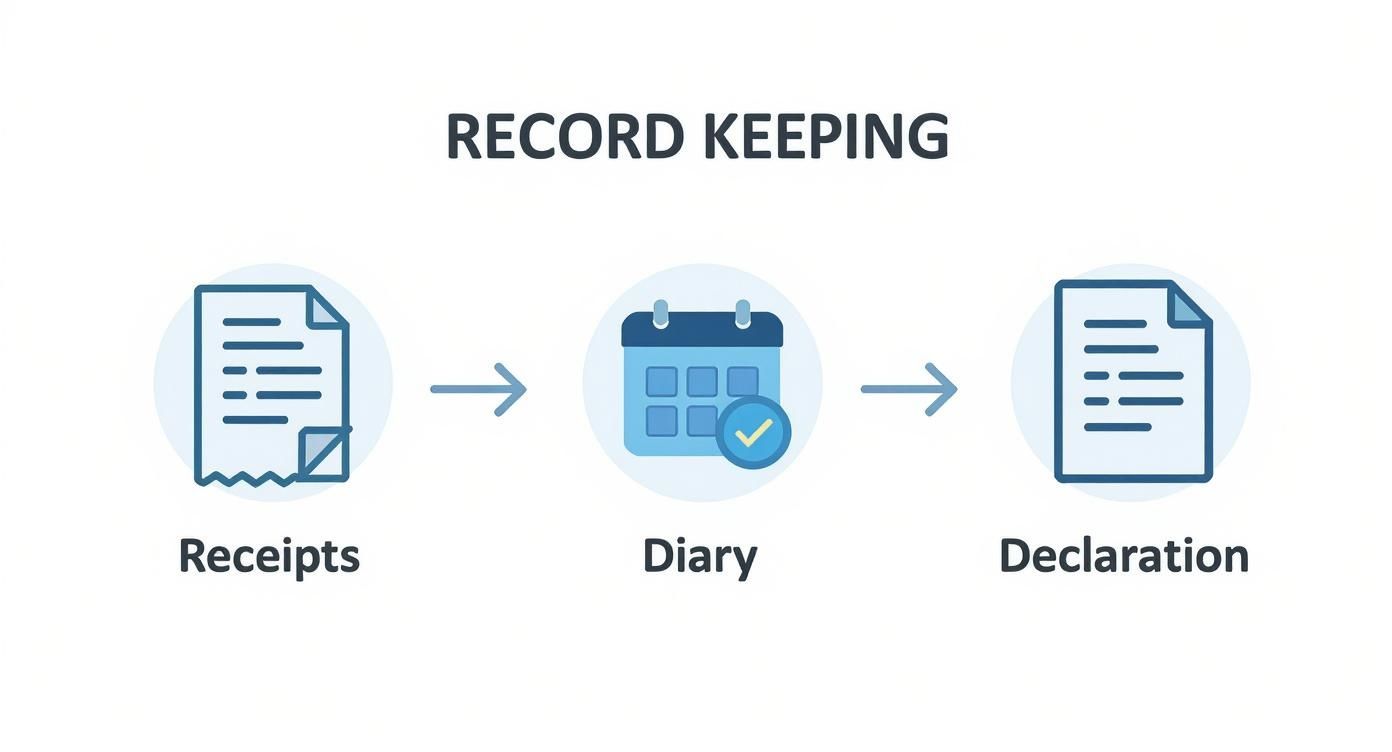
As you can see, the process flows logically from collecting receipts to keeping a diary and getting that all-important employer declaration. It's all about having solid proof.
Ultimately, seeing the whole picture helps both employers and employees make smarter choices. It takes the conversation from being just about rules to being about smart workforce management and personal financial planning. For a deeper look into financial management, check out our other resources on tax and compliance.
Common Questions About the Allowance
Even when you’ve got a handle on the basics, a few specific questions always seem to pop up when it comes to the working away from home allowance. Let’s clear up some of the most common queries we see, so you can apply this information with confidence. Please note that this information is general in nature and is not a substitute for professional tax advice tailored to your specific situation.
Is There a Maximum Time Limit for Working Away From Home?
This is a big one, and it’s something people often worry about. While the Australian Taxation Office (ATO) doesn't have a hard-and-fast rule like "12 months and you're out," the whole arrangement hinges on one crucial principle: it must be genuinely temporary.
If a work assignment keeps getting extended or becomes indefinite, it starts to look a lot more like a permanent move. Generally, assignments that stretch beyond 12 months will likely get a closer look from the ATO. The real test is whether you always plan to return to your normal home and if the job has a clear, foreseeable end date.
What Happens if My Allowance Exceeds the ATOs Reasonable Amounts?
Things change a little if your employer pays you an allowance that’s higher than the ATO’s reasonable amounts. The extra bit—the amount above the threshold—might need to be shown on your income statement, which could affect how it is treated for tax purposes.
It’s not forbidden to be paid more than the reasonable amount, but it does create extra reporting steps and potential tax implications. This is exactly why most employers stick to the official ATO guidelines—it just keeps things simple for everyone.
Can I Claim This Allowance if I Am a Contractor or Sole Trader?
The working away from home allowance is strictly a payment from an employer to an employee. So, if you're a contractor or a sole trader running your own show, you won't receive this type of allowance.
However, that doesn't mean you're out of options. You may be able to claim deductions for your travel expenses when you're working away from your main base of operations. The rules for these deductions are different, though, and they demand detailed records of what you actually spent. Getting this right is a common challenge, and our guide on how small business owners can navigate tax season offers some really practical tips for managing it all.
What if My Family Travels With Me?
This is a really important distinction to make. The allowance is specifically designed to cover the employee's extra living costs—and only the employee's. It doesn’t extend to cover expenses for your partner, kids, or other family members who might join you.
The purpose of the working away from home allowance is to offset the additional costs incurred by the employee due to their temporary work location. It is not intended to cover family travel or holiday expenses.
Any money spent on your family's accommodation, food, or fun is considered a private expense. To stay compliant, it's vital to keep a clear line between your work-related costs and your personal family spending.
Do I Need to Keep Receipts if My Allowance Is Below the Reasonable Amount?
Here’s one of the best parts of the "reasonable amounts" system. If your employer pays you an allowance that’s at or below the ATO’s official figure, you generally don't have to keep every single receipt to prove your spending.
But—and this is a big but—you must still be able to show that you actually spent the money. You also still need to keep other records, like your employer declaration and travel diary, to back up the entire arrangement. Honestly, holding onto major receipts, like for your accommodation, is always a smart move.
Can My Employer Pay My Expenses Directly Instead of an Allowance?
Yes, absolutely. This is another common way to handle things. Instead of giving you an allowance, your employer might just pay for your accommodation and other costs directly, or they might reimburse you for the exact amount you spent.
When an employer pays a hotel directly, it's considered a fringe benefit. When they pay you back for a cost you’ve already covered, it's a reimbursement. These are treated differently to an allowance for tax purposes, and separate rules, like fringe benefits tax (FBT), might come into play for your employer.
Trying to navigate the rules around allowances, deductions, and tax compliance can feel like a maze. At Genesis Hub, our mission is to make your finances simple so you can get back to what you do best. Whether you're a small business owner sorting out payroll or an individual needing tax guidance, our team is here with proactive, hands-on support. Get in touch for a free chat and see how we can strengthen your business. Learn more at https://genesishub.com.au.