Finding the right small business accountant in Melbourne is about so much more than just getting your taxes done on time. It’s about bringing a strategic financial partner into your corner—someone who can guide your growth and help you build a more profitable, resilient business.
Why Your Business Needs a Strategic Financial Partner

Too many small business owners see their accountant as a necessary evil, a box you have to tick once a year to keep the Australian Taxation Office (ATO) happy. This old-school mindset treats accounting as a pure compliance task. You hand over your paperwork, they crunch the numbers, and that's that.
But this perspective misses out on the incredible value a modern accountant brings to the table. The game has changed.
A proactive accountant isn’t just a historian cataloguing last year's finances; they’re a forward-looking strategist. They help you read the story your numbers are telling and use those insights to make smarter decisions for the future.
From Number Cruncher to Growth Partner
This shift from reactive compliance to proactive advice is where the magic happens. A great accountant becomes a core part of your support system, working with you to shape what's ahead instead of just reporting on what's already happened.
Below is a quick comparison showing just how different these two roles can be:
From Number Cruncher to Growth Partner
| Area of Focus | The Traditional Accountant | The Modern Strategic Advisor |
|---|---|---|
| Primary Goal | Ensure tax compliance and lodge documents on time. | Drive business growth, profitability, and efficiency. |
| Timing | Historical focus, looking at past financial data. | Forward-looking, using data for future planning. |
| Services Offered | Tax returns, bookkeeping, BAS lodgements. | Cash flow forecasting, budget analysis, tech advisory. |
| Relationship | Transactional, often limited to tax season. | Collaborative partnership with year-round engagement. |
| Key Question | "Did we meet our tax obligations?" | "How can we improve performance next quarter?" |
This partnership is one of the smartest investments you can make in your business’s future. For a deeper dive, check out our article on why every business needs an accountant.
A local Melbourne accountant also understands the city’s unique commercial landscape. They know the pressures a café in Fitzroy faces are different from the opportunities available to a tech startup in Cremorne. That local knowledge is priceless.
Navigating Melbourne's Expert Landscape
Thankfully, Melbourne’s vibrant entrepreneurial scene means you’re spoilt for choice. The city is packed with firms that specialise in small business services.
Research from Clutch.co shows there are at least 87 vetted accounting companies in Australia that focus on businesses with under $10 million in revenue, and a huge number of them are based right here in Melbourne.
Hiring the right accountant is a game-changing decision. It's the difference between having someone who just files your taxes and someone who helps you build a stronger, more sustainable business from the ground up.
At the end of the day, you're not just looking for a service provider. You need a partner who celebrates your wins, helps you navigate the tough times, and gives you the clear financial guidance needed to hit your biggest goals. Your search is for that perfect fit.
Defining What Your Business Actually Needs
Before you even think about searching for a "small business accountant Melbourne," you've got to get crystal clear on what your business actually needs from one. I’ve seen it time and time again: business owners jumping into meetings unprepared. It’s a bit like going grocery shopping when you’re hungry and without a list—you’ll walk out with a trolley full of things you don’t need and completely forget the essentials.
Taking a moment to map out your requirements first makes the whole process so much smoother. It helps you weed out the wrong fits straight away and lets you walk into consultations knowing exactly what you’re looking for.
Beyond Basic Compliance
Look, every single business has to lodge tax returns and Business Activity Statements (BAS). That’s just the ticket to play. But a good accountant does so much more than just keep you out of trouble with the ATO. The right one offers insights that actually help you grow.
Start by thinking about your industry. A bustling café in the CBD has a completely different set of financial headaches—like grappling with casual staff wages and fluctuating stock levels—compared to a software startup in Richmond, which might be more focused on its growth strategy.
An accountant who genuinely gets your industry will understand these nuances without you having to spell it all out. They've seen it before.
This process flow breaks down how to think about your requirements in clear, manageable chunks.
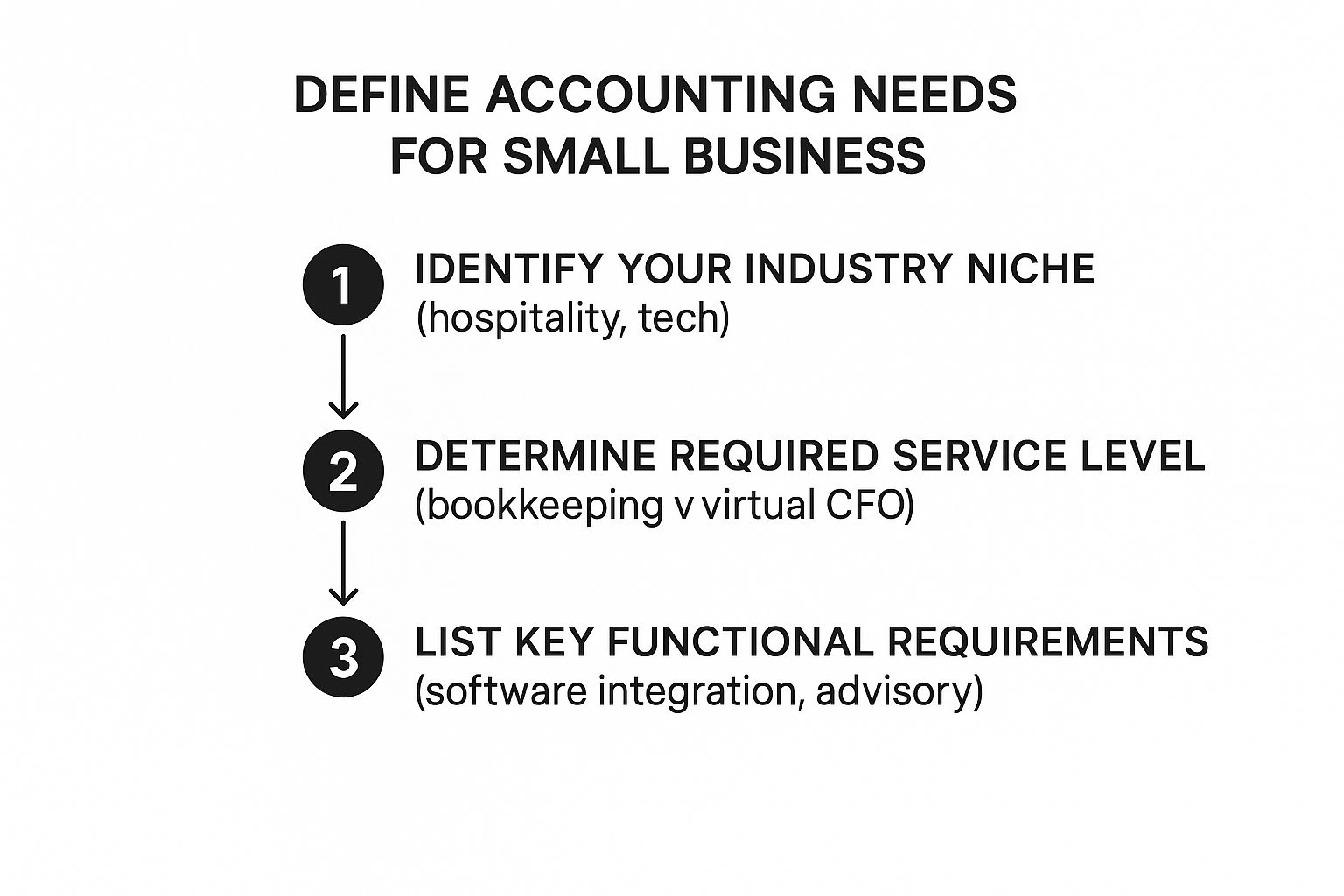
As you can see, it’s all about starting broad with your industry context and drilling down to the specific, functional services your business needs to really get ahead.
What Level of Service Do You Require?
Next up, think about how deep you need the support to go. Your needs will sit somewhere on a spectrum, from just handling the books to providing high-level strategic direction.
- Bookkeeping and Payroll: Are you just after someone to manage the daily grind of recording transactions, reconciling accounts, and making sure everyone gets paid correctly and on time? This is the foundational stuff.
- Compliance and Reporting: Is your main priority having an expert prepare and lodge your tax returns, BAS, and ensure you’re meeting all your ATO obligations?
- Business Advisory: Or are you looking for a true partner who can help with cash flow forecasting, budgeting, analysing your performance, and planning your next big move?
- Virtual CFO (vCFO): Maybe you need that top-tier strategic oversight—financial modelling, board-level reporting—but without the hefty salary of a full-time executive.
Getting this distinction right is crucial. An accountant who’s a wizard with compliance might not have the strategic chops to help you scale, and the reverse is also true.
I can't stress this enough: creating a detailed brief of your needs is the most important step in your search. It turns a vague hunt for an 'accountant' into a targeted mission to find the perfect financial partner for your business.
Building Your Accountant Wishlist
Finally, let’s get practical. It’s time to make a list of your non-negotiables and your nice-to-haves. This list will become your scorecard when you start talking to potential candidates. For some extra perspective here, our guide on comparing a tax accountant close to you vs an online accountant is a great read.
Jot down answers to questions like these:
- What accounting software are you on (Xero, MYOB, QuickBooks)? It’s a non-negotiable that they’re a pro with your platform.
- How often do you want to connect? Are you happy with a check-in every quarter, or do you need monthly strategy sessions to feel on top of things?
- Do you have any specific pain points? Think things like inventory management, project costing, or handling multi-currency transactions.
With this detailed brief in your back pocket, you’re ready to start vetting accountants. You can walk into those initial chats with confidence, knowing precisely what to ask and what a great answer sounds like.
How to Vet and Compare Potential Accountants
You’ve got your shortlist. Now it’s time to look past the slick websites and polished marketing material. A great website tells you they have a budget for design; it doesn’t tell you if they can help you navigate a cash flow crisis when things get tight.
This is where you separate the competent number-crunchers from the true strategic partners. It's the most critical step in finding the right small business accountant Melbourne has to offer for your unique situation.

First, Nail Down the Fundamentals
Before you start talking strategy and growth plans, you need to make sure the absolute basics are covered. A few non-negotiables should be at the top of your list to confirm right away, saving you from wasting time on consultations with unqualified people.
Start with their credentials. Are they a Chartered Accountant (CA) or a Certified Practising Accountant (CPA)? These aren’t just fancy letters after their name; they represent years of rigorous training, a commitment to ethics, and ongoing professional development.
Next, and this is a big one, check they are a registered tax agent with the Tax Practitioners Board (TPB). This is a legal requirement in Australia for anyone providing tax agent services for a fee. You can easily jump on the public TPB register online and verify this yourself in a few seconds.
Think of this initial check as pouring the foundation for a house. Without solid credentials and registration, any strategic advice they offer is built on shaky ground. Get this sorted before you even book a meeting.
Do They Actually Get Your Business?
Now we can get a bit more specific. An accountant might be a genius with construction clients but completely lost when it comes to the nuances of an e-commerce business. You need someone who speaks your industry's language.
Don't be afraid to ask them directly about their experience with businesses just like yours. For example, if you run a café in Melbourne, you could ask, "Have you worked with other hospitality businesses? What are the common challenges you help them with, like managing seasonal cash flow or staff costs?"
Their skill with your accounting software is just as important. In this day and age, being vaguely "familiar" with Xero or MYOB just doesn't cut it. You want an expert who can help you squeeze every last drop of value out of the platform, not just use it for basic data entry.
Here’s what to look for:
- Real Industry Experience: Do they have other clients in your sector? Can they talk knowledgeably about your specific challenges and opportunities without you having to explain everything?
- Deep Software Skills: Are they certified partners with your software (like a Xero Certified Advisor)? Ask them how they use it to provide proactive insights, not just historical reports from last quarter.
- A Focus on Growth: Frame your questions around the future. Try asking, "Based on what you know about my business, what would your top priorities be in the first three months to help us grow?"
The Questions That Reveal Their True Value
The first meeting is your chance to see how they think. Go beyond the obvious questions about fees and lodgement deadlines. The answers to these deeper questions will show you what they're really like to work with.
The demand for genuinely skilled accountants is high, particularly after the post-pandemic economic rebound. Xero's 'State of the Industry' report revealed that nearly 60% of Australian accountants expected to grow their revenue, with 27% planning to hire more staff just to keep up with client demand. This tells you that the best firms are busy, so you need to find one that prioritises a genuine partnership.
Here are a few questions I always recommend asking:
- "How do you prefer to communicate with clients, and how often should I expect to hear from you?"
- "Can you walk me through an example of how you helped another client improve their profitability?"
- "What are the top 2-3 financial metrics a business like mine should be obsessed with?"
Listen carefully to how they respond. Are they giving you generic, textbook answers, or are they engaging with the specifics of your business? The best small business accountants won't just answer your questions; they'll ask you thoughtful ones in return. That's how you know they're already thinking about your success.
Decoding Fee Structures to Find the Best Value
Figuring out how a small business accountant in Melbourne charges is one of the most important steps. It’s not just about avoiding a surprise bill; it’s about finding a partner whose value completely outweighs what you pay them. You need to look past the sticker price and understand how they charge, so you can find a structure that fits your budget and your business goals.
It's tempting to just go for the cheapest option, but that's rarely the best move. What you're really looking for is the best return on your investment.
The Main Pricing Models Explained
Most accountants in Melbourne will use one of three common pricing models. Once you get your head around these, you'll be able to compare quotes fairly and see what you’re actually getting for your money.
- Hourly Rates: This is the old-school way of doing things. You pay for the exact time your accountant spends on your work. It can work well for one-off jobs or a quick bit of advice, but the uncertainty is a killer. You might find yourself hesitating to call with a simple question because you’re worried about getting a bill for a five-minute chat.
- Fixed-Fee Packages: This model is getting really popular, and for good reason. You pay a set monthly or quarterly fee for a specific list of services, like your BAS lodgements and end-of-year tax work. The beauty of this is predictability. You know exactly what your accounting costs will be, which makes budgeting a breeze. No nasty surprises.
- Value-Based Pricing: This one’s a bit different. Instead of tracking hours, the fee is tied to the value and results the accountant delivers. You’ll often see this for high-level advisory work, like helping you with a major business restructure or strategic planning. The idea is that their expertise directly leads to a big financial win for you, and the fee reflects that.
The best way to think about this is to shift your mindset from "How much is this going to cost me?" to "What return will this investment get me?" A slightly more expensive fixed-fee package that includes proactive advice may be far better value than the cheapest hourly rate you can find.
How to Compare Quotes and Uncover True Value
Once you’ve got a few quotes in hand, your job is to dig deeper than just the dollar figure at the bottom. A lower price often means you’re getting less. You could end up paying extra for things you thought were included.
To make a smart choice, you need to ask some direct questions to get a crystal-clear picture of what you’re paying for. This helps flush out any hidden fees and makes sure you’re both on the same page from day one.
Key Questions to Ask About Fees:
- What services are actually included in this quote? Ask them to list everything, from BAS lodgements to phone calls and email support.
- What happens if I need help with something that's not in the package? You need to know their charges for any out-of-scope work.
- Is my accounting software subscription (like Xero) included in your fee? Some accountants bundle this in, others don’t. It’s a simple question that can save you a few hundred dollars a year.
- How often will we sit down and review my business's financial performance? This gives you a good idea of how proactive they’ll be.
Getting these financial details sorted out upfront lets you choose an accountant that truly fits your business. This kind of clarity is what builds a strong, long-term relationship, turning your accountant from a cost into a genuine asset for your company's growth. Please note that this guide does not offer tax advice.
Sealing the Deal: Choosing and Onboarding Your New Accountant

You’ve done the hard yards. You’ve met the candidates, figured out their fees, and now you’re down to the final two or three. Honestly, making that final call often comes down to a mix of solid due diligence and a bit of gut instinct.
But before you sign anything, do one last crucial thing: check their references.
Speaking to a couple of their current clients gives you the kind of real-world insight a sales pitch just can't provide. Ask them about communication, how responsive the accountant is, and if they've genuinely helped the business grow. It’s this final check that confirms you're picking the right small business accountant in Melbourne.
It’s a good market to be in, too. The number of accounting firms in Australia has been growing year on year, which means there are plenty of quality partners to choose from. You can see the trend for yourself by checking out the latest industry figures from IBISWorld.
Laying the Groundwork for a Smooth Start
Once you’ve made your choice, the next step is a smooth onboarding. A messy, disorganised start can create friction from day one, so a little prep work here really sets the tone for a great long-term partnership.
First up, get your documents in order. Your new accountant needs access to your financial world to hit the ground running.
Your Onboarding Checklist:
- Proof of ID: The standard 100-point check for all directors.
- Business Basics: Your ABN, TFN, and any ASIC registration documents.
- Software Access: Logins for your Xero, MYOB, or QuickBooks account.
- Past Financials: Copies of previous tax returns and financial statements.
Having all this ready to go shows you’re organised and lets your accountant get straight to work, rather than chasing you for the basics.
What to Expect in the First 90 Days
The first three months are all about finding your rhythm and setting clear expectations. This isn't just about handing over the books; it’s about bringing a new strategic partner into your business.
The onboarding phase is your opportunity to build a strong foundation. Clear communication and a well-defined plan for the first 90 days are critical for aligning your goals and ensuring your new accountant can start adding value from day one.
In this initial period, you should be working together to:
- Dig into the Past: They’ll analyse your previous financials to get a clear picture of your business's health and spot any quick wins or red flags.
- Set Up Comms: Decide how you’ll communicate—email, calls, a dedicated Slack channel—and lock in regular check-ins, whether that's monthly or quarterly.
- Define Your Goals: Get on the same page about what success looks like. Is it cleaning up messy books, improving cash flow, or mapping out a five-year growth plan?
A structured start like this ensures nothing falls through the cracks. If you're ready to kick off this process with a team that gets it, why not schedule a free consultation? Investing a little time upfront doesn't just get you an accountant; it builds a partnership that pays dividends for years to come.
Still Have a Few Questions About Hiring a Melbourne Accountant?
Even when you've done your homework and shortlisted a few great candidates, some practical questions always seem to pop up right at the end. That’s completely normal.
Getting these last few details ironed out is often the final step to feeling confident you’re making the right call for your business. Let's clear them up.
Bookkeeper vs. Accountant: What's the Difference, Really?
This is a classic point of confusion, but the roles are actually quite distinct. Think of your bookkeeper as the person on the ground, meticulously recording all your daily financial transactions. They’re the masters of data entry, bank reconciliations, and making sure your financial records are spot-on and up-to-date.
An accountant, on the other hand, takes that data and zooms out to see the big picture. They're the ones preparing your formal financial statements, offering strategic advice, and helping you plan for the future. While many accountants do offer bookkeeping, their real value lies in interpreting the numbers, not just logging them.
A simple way to look at it: The bookkeeper builds the house, laying every single brick perfectly. The accountant is the architect who designed the blueprint, making sure the whole structure is sound and will serve you well for years to come.
Should I Hire a Local or a Remote Accountant?
With cloud accounting platforms like Xero and MYOB, it’s never been easier to work with someone on the other side of the country. But for a Melbourne business, sticking with a local accountant brings a few advantages that technology can't quite match.
A local expert just gets the Melbourne economy. They have a real-world understanding of state-specific rules like WorkCover Victoria and local payroll tax thresholds. This on-the-ground knowledge can be a lifesaver.
And honestly, sometimes nothing beats a face-to-face meeting to really hash out a strategy. Plus, a good local accountant often has a trusted network of other Melbourne professionals—lawyers, brokers, you name it—which can be a massive asset as you grow.
When Is the Right Time to Hire an Accountant?
The short answer? Yesterday. But seriously, as early as you possibly can, ideally before you even officially launch. So many business owners make the mistake of waiting until their first tax season is bearing down on them, but by then, costly mistakes might already be locked in.
Bringing an accountant in from day one means you get crucial advice on the right business structure—sole trader, company, trust? They’ll help you set up your accounting systems properly from the get-go, making sure you’re compliant from day one. It’s not just about avoiding headaches; it's about building a rock-solid financial foundation from the start.
How Much Does a Melbourne Accountant Actually Cost?
There's no one-size-fits-all price tag. The cost really depends on how complex your business is and what you need them to do. For a basic compliance package that just covers your tax and BAS, you might be looking at fees starting from a few hundred dollars a month.
But if you’re after more comprehensive advisory or a virtual CFO service, that could run into several thousand dollars a month.
The trick is to get detailed quotes based on a very clear scope of work. And remember, don't just focus on the price tag. The real question is about the value and return on investment. An accountant who costs a bit more but helps you boost profitability is always the smarter move.
Ready to build a stronger financial future for your business with a proactive partner? The team at Genesis Hub specialises in helping Melbourne businesses like yours go beyond compliance to achieve real growth.